Cordless mowers have changed what “large yard” actually means for homeowners. Battery platforms now deliver the run time and cutting width that used to require a gas tank, and the trade-offs have shrunk: less noise, no oil changes, and far fewer fumes hanging in the air while you work. The right pick depends on your terrain, slope, and how much grass you cut each week. I put together six cordless walk-behind options that handle half an acre and up, so you can match the mower to the yard instead of the other way around.
A Closer Look At The Lineup

Greenworks 80V 21in Push Lawn Mower

Casince 17in Cordless Walk Behind Lawn Mower
Worx WG733.1 20V 14in 2-in-1 Mower
Worx WG735 40V 14in IntelliCut Mower

Worx WG745 40V 17in 1/4 Acre Mower

EGO POWER+ LM2135SP 21in Self-Propelled Mower
The Details Behind The Selections
The 80V platform is the muscle car of Greenworks’ outdoor lineup, and this 21-inch push mower shows why that voltage class matters. A brushless motor (a motor with no internal brushes, so less friction and longer life) drives a steel deck wide enough to cut a walking path most adults can’t quite stride across in one step. For homeowners with a half acre or more of open lawn, that width translates to fewer passes and a noticeably shorter Saturday.
Single-lever height adjustment keeps the controls simple, which matters when you want to switch between cool-season fescue and warm-season Bermuda without digging through a manual. Owners commonly report the rapid charger getting a depleted 4.0Ah battery back to full in roughly an hour, a useful trait if you split mowing across two short sessions.
The Case For It
- 21-inch steel deck covers ground quickly on open lawn
- Brushless motor delivers strong torque and longer service life than brushed designs
- Rapid charger brings a 4.0Ah battery back online in roughly 60 minutes
- Single-lever height adjustment, no tools needed for cut-height changes
Things To Consider
- Run time drops in dense or wet grass, so thick lawns may need a second battery
- Steel deck adds weight, which can wear you out on sloped terrain
- No self-propel, so pushing on hills takes more effort than the EGO below
Key Specs
Who It Suits Best
Homeowners with half an acre or more of relatively flat lawn who want fewer passes and the runtime headroom that an 80V battery delivers.
Consider Something Else When
The EGO POWER+ LM2135SP is a better fit for sloped yards, since its self-propelled drive cuts the effort of pushing a heavy mower uphill.
Casince isn’t a household name the way Greenworks or EGO is, but this 17-inch walk-behind earns its place by pairing two 20V batteries with six height positions in a frame most people can fold up against a garage wall. The dual-battery setup (where two packs share the load and extend total run time) gives smaller yards more cutting headroom than a single-battery budget mower typically offers.
For a homeowner stepping away from gas for the first time, the height range of roughly 1 to 3 inches covers most lawn types. Six steps is generous at this size class, and the deck width lands in the middle of the pack: wider than the 14-inch Worx models below, narrower than the 21-inch heavy hitters.
Practical Pluses
- Two 20V 4.0Ah batteries extend runtime and reduce mid-cut charging stops
- Six height settings from 1 to 3 inches cover most turf preferences
- 17-inch deck splits the difference between compact and full-size
- Foldable handle helps for garage or shed storage
Trade Offs
- 20V platform won’t match the torque of 40V or 80V mowers in thick grass
- Plastic deck is lighter but less durable than the Greenworks steel deck above
- Brand recognition is thinner, so long-term parts availability is harder to predict
Made For
First-time cordless mower owners working with a small or mid-size yard who want simple controls and a wallet-friendly entry point.
Look Elsewhere When
The Worx WG745 is the better fit if you already own Worx PowerShare batteries or want a wider 17-inch deck that runs on the more common 40V platform.
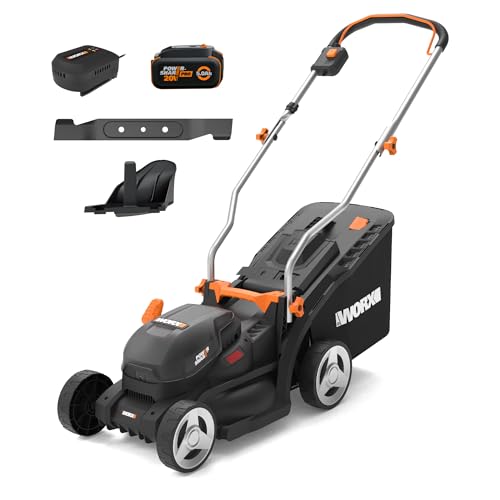
The WG733.1 is the smallest, lightest mower in the Worx family, and that simplicity is its point. A 14-inch deck and a 20V PowerShare battery make it approachable for anyone who has wrestled a heavy walk-behind up a basement stair or around tight garden corners. For a quarter-acre or less with narrow side yards, it earns its keep without overcomplicating the chore.
The 2-in-1 design means you can switch between mulching (chopping clippings fine and dropping them back into the lawn as natural nutrients) and bagging (collecting clippings in a rear bag for disposal or composting) without swapping a heavy deck plate. Owners commonly report that the compact size makes storage in a small shed genuinely painless, a detail that matters when space is tight.
Real Benefits
- Lightest mower in the Worx lineup, easier to maneuver around landscaping
- 5.0Ah battery covers up to 3,200 square feet per charge
- 2-in-1 design lets you mulch or bag without a separate deck plate
- Brushless motor improves power efficiency and runtime over brushed designs
Points To Note
- 14-inch deck means noticeably more passes on anything over a small yard
- 20V battery delivers less torque in tall grass than the 40V Worx models below
- Plastic deck holds up to typical suburban use but won’t take abuse like a steel deck
Quick Facts
Right Fit For
Apartment renters, small-lot homeowners, and anyone who needs a mower that’s easy to lift, store, and push around tight landscaping.
Skip It When
The Worx WG745 makes more sense for a quarter acre or larger, since its wider 17-inch deck and dual-battery 40V setup cut that ground far more efficiently.
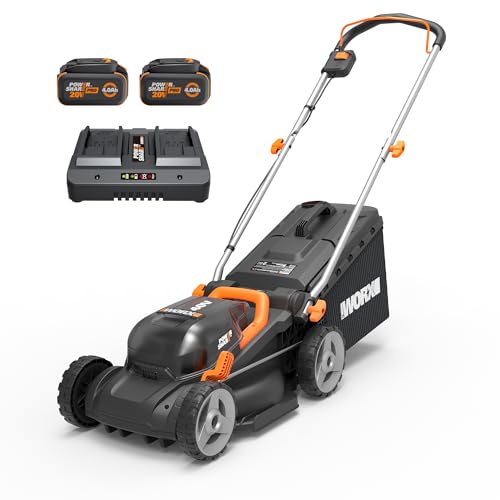
The WG735 takes the same compact 14-inch footprint as the WG733.1 above and steps up to a 40V system with IntelliCut technology, a feature that automatically increases torque when the blade meets thicker patches and dials back when grass thins out. For lawns that swing between sparse and dense from week to week, that adaptive response keeps the cut consistent without you babysitting the trigger.
An optimized deck with improved airflow channels clippings more cleanly toward the bag, which matters for homeowners who bag rather than mulch. The trade-off is run time: one 20V 4.0Ah battery delivers enough juice for an eighth of an acre, so anything larger means planning around a recharge.
What Makes Sense
- IntelliCut adjusts torque on the fly for variable grass thickness
- 40V platform handles thicker grass than the 20V WG733.1 above
- Brushless motor for quieter operation and longer motor life
- Compatible with the Worx PowerShare battery family
Worth Noting
- Single battery limits real-world coverage to around an eighth of an acre
- 14-inch deck is slow on larger lawns compared to the 17-inch WG745
- Adaptive cutting adds small complexity to a class that usually keeps things simple
Best Suited To
Homeowners with an eighth-acre lot where grass thickness varies week to week and they want a smarter cut without stepping up to a wider deck.
Not Your Match When
The Worx WG745 is the better call for quarter-acre lawns, since it pairs a wider 17-inch deck with a dual-battery setup for full-yard run time.
The WG745 sits in the middle of the Worx lineup, and for a quarter-acre yard it’s the most well-rounded of the brand’s cordless walk-behinds. Two 20V 4.0Ah PowerShare batteries run in tandem, doubling available energy and giving the mower the run time to finish a typical quarter-acre lot on a single charge. The 17-inch deck splits the difference between the compact WG733.1 above and the full 21-inch Greenworks at the top of the list.
PowerShare compatibility is the quiet selling point: the same batteries slot into over 140 Worx tools, outdoor equipment, and lifestyle products. For homeowners already invested in that ecosystem, the WG745 essentially comes pre-equipped with backup power.
A Few Highlights
- Dual 20V batteries deliver enough run time for a quarter acre per charge
- 17-inch deck balances coverage with manageable size
- Batteries share with 140+ Worx tools, which simplifies spares
- Brushless motor adds torque and extends motor service life
Small Caveats
- Dual-battery design adds weight versus single-pack models
- No self-propel, so the EGO LM2135SP below is easier on slopes
- Real coverage depends on grass type, height, and terrain
Feature Snapshot
Who Will Love This
Homeowners with a quarter acre who already use Worx tools and want a deck and battery setup sized precisely for that lot.
A Better Fit Elsewhere
The Greenworks 80V 21in Push Lawn Mower is the smarter pick for half-acre yards, where its wider deck and higher-voltage platform handle longer cuts without battery swaps.
The LM2135SP is the most ambitious cordless walk-behind in this roundup, and the price tag reflects it. A self-propelled drive system (the rear wheels motorize themselves, so the mower moves forward under its own power and you just guide it) takes the effort out of slopes that would wear out your shoulders on a push mower, and the 56V 7.5Ah battery delivers torque that EGO compares to gas-engine output. For homeowners with slopes, thick turf, or a yard big enough to justify the upgrade, the difference shows up the first time you mow.
The Select Cut multi-blade system ships with three interchangeable lower blades: a mulching blade, a high-lift bagging blade, and an extended-runtime blade. Swapping blades is the kind of detail that sounds fussy until you want a clean bagged cut one week and longer run time the next.
Where It Delivers
- Self-propelled drive cuts fatigue on slopes and large yards
- Select Cut multi-blade system adapts to mulching, bagging, or extended runtime
- 56V 7.5Ah battery plus included 5.0Ah backup extends usable run time
- 21-inch deck rivals gas mowers for cutting width
Honest Caveats
- Premium pricing makes it overkill for small, flat lots where the Worx WG745 above would do the job
- Self-propel adds mechanical complexity that simpler mowers don’t have
- Real-world run time drops in tall or wet grass, just like every cordless mower here
At A Glance
Perfect Match For
Homeowners with slopes, thick turf, or a yard large enough to justify the upgrade who want gas-like performance without the gas.
Another Choice May Suit
The Greenworks 80V 21in Push Lawn Mower is the smarter buy on flat half-acre lawns where self-propel isn’t necessary and the budget benefits from skipping it.
What To Weigh Before Choosing Lawnmowers For Large Yards
Deck Width And Coverage Math
A 14-inch deck means roughly 40 more linear feet of walking per 1,000 square feet of lawn than a 21-inch deck. That gap adds up fast on a half acre. For lots bigger than a quarter acre, 17 to 21 inches is the practical range where battery run time and cutting width actually meet.
Voltage, Amp Hours, And Real Run Time
Voltage (V) tells you the platform’s potential torque, while amp hours (Ah) tell you how much energy the battery holds. A 20V 5.0Ah pack is not the same as a 40V 4.0Ah pack; both store roughly 100 watt-hours of energy (the actual usable work the battery can deliver), but they deliver it differently. Dense, wet grass leans on voltage; long runtime leans on amp hours.
Push Vs. Self-Propelled
Push mowers cost less and weigh less, which helps on flat ground and in storage. Self-propelled mowers save your shoulders and back on slopes, and the EGO LM2135SP above is the standout choice when the yard tilts. Pick based on your terrain, not on feature lists.
Battery Ecosystem And Spare Packs
Cordless mowers live or die by their batteries. Worx PowerShare packs work across 140+ tools, which makes backup power easy. Greenworks and EGO run their own ecosystems with strong platform depth. Buying into a brand’s broader lineup can save real money if you already own trimmers or blowers.
Key Considerations Across These Picks
Wrong Turns To Avoid
A common trap is choosing a 14-inch deck for a yard that’s bigger than a quarter acre. The math doesn’t work: more passes mean more battery drain per session, and you’ll burn through packs faster than you expected. Another mistake is assuming voltage alone equals performance; a 40V pack with low amp hours can underdeliver in thick grass. Match deck width to lot size, and match battery capacity to grass type.
Where The Extra Money Goes
The jump from the Casince 17-inch to the EGO LM2135SP buys three real things: a self-propelled drive, a wider cutting width, and the Select Cut blade system. On flat lawns, none of those features justify the gap. On slopes or thick turf, they pay back every weekend. Spending up only makes sense when the upgrade maps to a problem you actually have.
Frequently Asked Questions
How big of a yard can a cordless mower really handle?
Most cordless walk-behinds in this roundup handle between an eighth and a half acre per charge. Real coverage depends on grass height, moisture, and terrain, so plan on 20 to 30 percent less than the rated spec for typical suburban conditions.
Is a brushless motor worth the extra money?
Brushless motors (which use electronic control instead of physical brushes to drive the rotor) generally run cooler, last longer, and deliver more torque than brushed designs of the same voltage. For a mower you’ll use weekly through the summer, the upgrade tends to pay back in motor life alone.
Do I need self-propelled for a large yard?
Self-propelled drive matters most on slopes and uneven terrain. On flat ground, a well-balanced push mower like the Greenworks 80V gets the job done with less cost and less mechanical complexity.
Can I leave the battery on the mower between uses?
Most manufacturers recommend removing the battery for long-term storage and storing it at room temperature. Leaving a pack in a hot garage or a cold shed accelerates capacity loss over time.
How long do cordless mower batteries typically last?
With normal use and proper storage, lithium-ion mower batteries often deliver three to five seasons of service before noticeable capacity loss. Heavy users who mow twice a week may see shorter life, occasional users may see longer.
Wrap Up
The right cordless mower for a large yard comes down to a clean match between lot size, terrain, and how much grass you actually push through each week. Match the deck width to the acreage, the voltage to the grass type, and the drive type to your slope. From the compact Worx WG733.1 to the self-propelled EGO LM2135SP, every pick above earns its slot by solving a specific kind of large-yard problem cleanly, and any of them would make Saturday morning quieter than it used to be.