Nothing derails a Saturday yard plan like turning the key on a riding mower and getting a click, or nothing at all. The right charger keeps that 12V system topped up through winter storage, recovers a battery that got neglected, and saves the cost of a tow or a replacement. I put together this list for homeowners who want a dependable match for their riding mower, not a one-size-fits-all trickle box that takes all weekend to fill a dead battery.
A Quick View Of The Lineup

Battery Tender Junior 12V, 750mA Charger and Maintainer
Battery Tender Junior 12V, 800mA Battery Charger and Maintainer
Honda CV5080N1U Fast Electric Lawn Mower Battery Charger

Battery Tender Plus 12V, 1.25 AMP Battery Charger and Maintainer

NOCO GENIUS1 1A 6/12V Smart Battery Charger and Maintainer
NOCO GENIUS10 10A 6/12V Smart Battery Charger and Maintainer

NOCO GENIUS5 5A 6/12V Smart Battery Charger and Maintainer

Honda DP5080 8Ah Lawn Mower Battery
Why These Options Stand Out
The Battery Tender Junior sits at the top of this list because it has earned a long track record as a hands-off maintainer for powersport batteries, and that same use case fits a riding mower sitting in a cold garage for months. The 750mA output is slow by design: it brings a 12V lead-acid battery up to full charge through a four-step program, then drops into a float mode that holds voltage steady without overcooking the cells.
For most homeowners who just want to plug in the mower over winter and forget it, that gentle approach is exactly right. The unit works with flooded, AGM, and gel cell batteries, which covers the vast majority of factory-installed riding mower packs. I would point first-time owners, or anyone storing a mower in an unheated shed, to start their search right here.
What Stands Out
- Four-step charging handles initial fill, bulk charge, absorption, and float automatically, so there is no risk of leaving it connected too long
- Compatible with flooded, AGM, and gel cell 12V lead-acid batteries, which covers most riding mower setups
- Small enough to leave tucked beside the mower for the entire off-season
- Float mode keeps the battery topped up without manual monitoring
Things To Consider
- The 750mA output is best for maintenance rather than reviving a deeply discharged battery in a hurry
- Not designed for lithium chemistries, so lithium-equipped mowers will need a different pick
Quick Facts
Who It Suits Best
Homeowners storing a traditional lead-acid riding mower battery through winter and wanting a charger they can plug in once and ignore.
Consider Something Else When
Owners running a lithium-powered mower should look at the NOCO GENIUS5, which handles lithium chemistries alongside lead-acid.
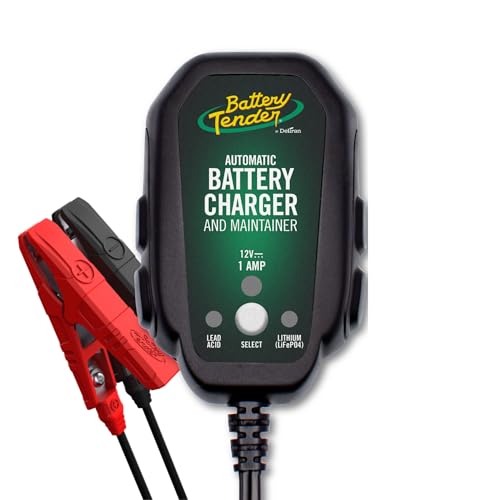
Where the first Battery Tender on this list stops at lead-acid, the 800mA Junior adds a switch on the housing that toggles between lead-acid and lithium chemistries. For a household that owns a gas riding mower today and might buy a lithium-equipped electric model in a few years, that flexibility avoids owning two separate chargers. The 800mA current is a small bump over the entry-level Junior, which shaves a bit of time off a full charge.
I would reach for this version when the garage is a mixed fleet: a riding mower, a couple of motorcycles, maybe a snowmobile. Push-button chemistry switching is more useful than it sounds, especially when you cannot remember which battery in the back corner is which. Compared with the 750mA Junior, the trade-off is a hair more money for genuine future-proofing.
Practical Advantages
- Switchable lead-acid and lithium modes handled by an internal microcontroller, so chemistry selection is one button press
- Works with AGM, flooded, gel, and LiFePO4 battery types, covering powersports and modern electric mowers
- At 800mA, a modest upgrade in speed over the entry-level maintainer for the same hands-off storage behavior
Worth Noting
- Still a low-amp unit, so reviving a fully dead riding mower battery takes patience
- Owners with a single lead-acid mower only may not benefit enough from the lithium mode to justify the cost jump over the first pick
Made For
Households with a mix of lead-acid and lithium powersport batteries who want one charger that handles both chemistries cleanly.
Look Elsewhere When
Someone needing fast recovery on a deeply discharged battery should consider the NOCO GENIUS10 for its much higher 10A output.
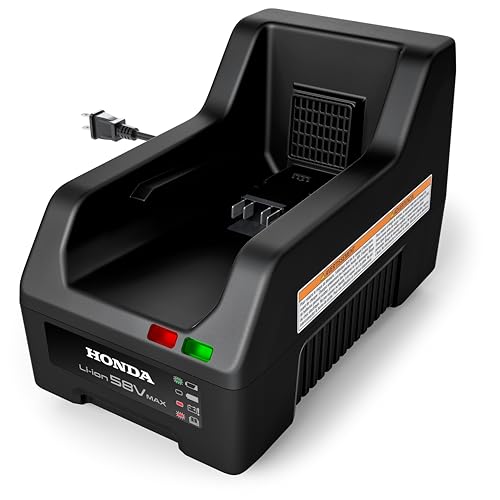
The Honda CV5080N1U is not a general-purpose charger; it is built around Honda’s patented battery connector, the same one found on the company’s 58.8V electric mower platform. The benefit is a tight, wobble-free connection that delivers a stable charge and avoids the gradual connector wear that generic clamps can cause on this specific design. Output is 58.8V at 8A, which translates to a full top-up in roughly 60 minutes for the 8Ah pack.
For Honda electric mower owners, this is the charger the brand actually spec’d for the tool. For anyone running a different platform, it is not a viable option, since the connector and voltage will not match. I see it as a clear fit for one specific reader profile rather than a universal recommendation.
Well-Handled Touches
- Patented Honda connector locks the charger in place without side-to-side play, protecting the battery terminals over time
- Wall-mount-ready housing keeps the charger off the workbench in a busy garage
- Charges the 8Ah pack in around 60 minutes, which suits quick turnarounds between mowing sessions
Room For Improvement
- Limited to Honda’s 58.8V electric mower platform, so it does not double as a general 12V maintainer
- The 12Ah pack takes closer to 90 minutes, which is still reasonable but worth knowing for larger properties
Technical Sheet
Best Suited To
Owners of Honda’s 58.8V electric riding mower platform who want the charger engineered for their specific battery.
A Better Fit Elsewhere
Anyone with a traditional 12V riding mower should look at the NOCO GENIUS5 for broader compatibility.
The Plus steps up to 1.25A, which is roughly 65% more current than the Junior model and enough to push a partial charge into a riding mower battery overnight rather than over a full day. It still ends in a float stage, so leaving it connected indefinitely is safe. The internal algorithm is California-compliant, which is a small point in its favor if you live in that market and care about energy standards.
Where the Junior models are ideal for pure maintenance, the Plus makes more sense when the battery occasionally runs low between uses. I see it fitting a multi-vehicle garage that includes the riding mower plus a car or two on the same charger rotation. Compared with the GENIUS5 on this list, it lacks lithium support and a desulfation mode, so it is a lead-acid specialist first.
Key Advantages
- 1.25A output fills a partially discharged battery noticeably faster than the Junior maintainers
- Float mode kicks in after the bulk charge, so it is safe to leave connected across the season
- Strong fit for AGM and flooded batteries in riding mowers, lawn tractors, and classic cars
Points To Note
- No lithium compatibility, so electric mower owners with LiFePO4 packs will need a different charger
- Lacks the diagnostic and desulfation features that the NOCO line offers at a similar price band
Right Fit For
Garages that run a riding mower alongside cars, trucks, or other lead-acid vehicles and want one charger to rotate between them.
Skip It When
Buyers wanting lithium support and battery recovery features in the same box should consider the NOCO GENIUS10 instead.
The GENIUS1 is the smallest of the NOCO line and the one I would hand to a homeowner with a small riding mower battery and limited storage space. The 1A output is enough for a 12V system up to about 30Ah, which fits compact lawn tractors more than heavy-duty 35Ah-plus packs. It handles both 6V and 12V batteries, lead-acid and lithium, which makes it the most chemistry-flexible option at the low end of the lineup.
For most full-size riding mowers, I would nudge shoppers up to the GENIUS5 or GENIUS10, since 1A on a 30Ah battery is slow going. For a smaller mower, a generator, or a stored classic car, it is a tidy little charger that does not take up much shelf room.
A Few Highlights
- Tiny enclosure fits on a crowded garage shelf or hangs on a hook without dedicated space
- 6V and 12V compatibility covers a wider range of vehicles than most maintainers in this price band
- Works with lead-acid, AGM, gel, and lithium-ion chemistries for cross-fleet flexibility
Honest Caveats
- 1A is slow on larger riding mower batteries, so a deep recovery can take the better part of a day
- Owners with bigger 35 to 50Ah mower batteries will want the higher-amp GENIUS5 or GENIUS10 instead
Who Should Grab It
Shoppers with smaller riding mowers, compact lawn tractors, or other 12V equipment up to around 30 amp-hours who want a compact charger.
Swap It Out When
A full-size riding mower with a larger battery calls for the NOCO GENIUS5, which has the current to handle it without the long wait.
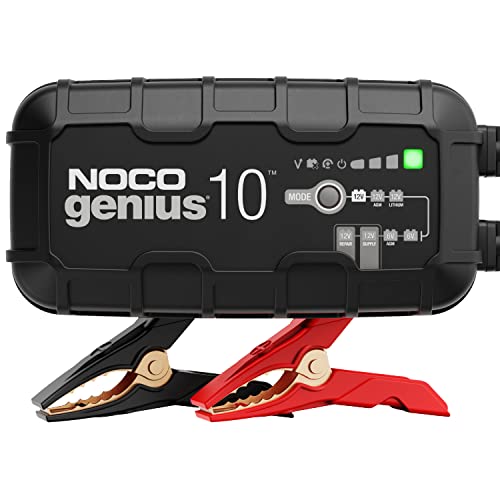
The GENIUS10 is the workhorse of the NOCO consumer line: 10A output, support for batteries up to 230Ah, and a feature set that goes well beyond simple charging. Built-in desulfation (a process that uses controlled pulses to break down lead sulfate crystals on tired battery plates), temperature compensation, and a force mode for severely discharged packs make it a true shop tool, not just a maintainer. For a homeowner with a large riding mower and a tendency to forget the battery over winter, that recovery capability is genuinely useful.
Where the Junior models and the GENIUS1 are made for steady, slow maintenance, the GENIUS10 is the one to grab when a battery has been left too long and needs a real push. I see it as the upgrade pick for owners with multiple vehicles, a heavy-duty lawn tractor, or a diesel riding mower. It costs more, but the wider current range covers both daily maintenance and emergency recovery in one box.
Bright Spots
- 10A output fills large riding mower batteries in a fraction of the time that small maintainers need
- Desulfation mode can revive batteries that have sulfated from long storage, which extends their useful life
- Temperature compensation adjusts the charge profile for hot garages or cold sheds, protecting the battery across seasons
- Force mode lets the charger attempt a recovery on a battery that has dropped below a normal voltage threshold
Potential Drawbacks
- Costs more than the entry-level maintainers, which may not suit shoppers only storing a battery for a few weeks
- Bulkier than the 1A or 5A models, so it needs a dedicated spot on a bench or shelf
- Overkill for small mowers with low-capacity batteries, where the GENIUS1 or GENIUS5 does the job for less
Spec Overview
Perfect Match For
Owners of large riding mowers, multiple powersport vehicles, or anyone who has dealt with a sulfated battery and wants one charger that handles recovery and maintenance.
Where A Sibling Pick Shines
Buyers on a tighter budget or with a smaller lawn tractor get plenty of value from the NOCO GENIUS5 at a lower amp rating.
The GENIUS5 is the middle child of the NOCO line, and for most riding mower owners it hits the sweet spot. The 5A output is a meaningful step up from the 1A GENIUS1, so a typical 30 to 50Ah mower battery fills in a reasonable window rather than overnight. It carries the same desulfation, force mode, and temperature compensation features as the GENIUS10, scaled to a more modest current.
For a homeowner with one riding mower and no plans to run a commercial shop out of the garage, the GENIUS5 is the one I would recommend without much hesitation. It charges faster than the Junior models, supports more chemistries, and recovers a neglected battery that the smaller chargers would struggle with. The trade-off versus the GENIUS10 is straightforward: half the current, half the recovery speed, and a lower price to match.
Useful Highlights
- 5A output handles the typical 30 to 50Ah riding mower battery in a few hours rather than overnight
- Supports 6V and 12V systems plus wet, gel, AGM, and LiFePO4 chemistries for full flexibility
- Desulfation mode extends the life of batteries that have sat discharged for a while
- Force mode and temperature compensation come standard, matching the larger GENIUS10
Possible Compromises
- Slower than the GENIUS10 for very large or deeply discharged batteries, which matters for high-capacity setups
- For a single small mower, the GENIUS1 covers the same chemistries at a lower price
Who Will Love This
Homeowners with a typical riding mower battery who want faster charging and battery recovery features without paying for the full 10A unit.
Reach For A Different Pick When
Owners running a large diesel riding mower or multiple batteries at once will benefit more from the NOCO GENIUS10’s higher output.
The Honda DP5080 is a battery rather than a charger, and it earns its spot on this list for a specific reason. When the existing pack in a Honda electric mower has reached the end of its life, replacing it with the OEM (Original Equipment Manufacturer) part is the path of least resistance. The 8Ah lithium-ion cell uses Honda’s patented ribbed notch and spring-loaded connector, so it locks into the mower the same way the original did, with no wobble or side-to-side play.
Real-world run time is in the 30-minute range per charge, which is enough for about a quarter acre of mowing, depending on grass thickness and terrain. For a Honda electric mower owner whose battery has lost capacity, this is a clean swap. For anyone with a different platform, it is not a compatible replacement, which is the main reason it sits in the specialty slot.
Strong Points
- OEM Honda design means a guaranteed fit and the same connector reliability as the factory-installed battery
- Spring-loaded connector and ribbed notch keep the pack stable during use, even on rough terrain
- 8Ah capacity delivers around 30 minutes of mowing per charge, suited to small to mid-size lawns
Small Limitations
- Limited to Honda’s 58.8V platform, so it does not serve as a universal replacement for other brands
- Run time scales with grass conditions, so thicker or wet lawns may drain it faster than the 30-minute estimate
Feature Snapshot
Built With In Mind
Honda electric mower owners who need to replace a worn or failed factory battery with a guaranteed compatible pack.
Not Your Match When
Shoppers with a different brand of electric mower should pair the Honda CV5080N1U charger with a manufacturer-approved battery for their platform, or look at the NOCO GENIUS5 for a multi-chemistry charger.
Choosing The Right Charger For Your Riding Mower
The first decision is the chemistry question. Traditional riding mowers run 12V lead-acid batteries, which is the most common type and the easiest to match. Newer electric riding mowers use lithium-ion packs at higher voltages, often with proprietary connectors, and they need a charger built for that specific platform. Matching the chemistry is non-negotiable: a lead-acid charger used on a lithium battery, or vice versa, can shorten pack life or fail to charge at all.
Next, look at the charger’s amp rating, which is the measure of how much current it pushes into the battery each hour. Small maintainers in the 750mA to 1A range are best for keeping a healthy battery topped up over long storage. Mid-range 5A chargers handle most riding mower batteries in a few hours and are the practical choice for a single owner. Heavy-duty 10A units make sense for large batteries, frequent deep discharges, or shops that maintain multiple vehicles.
Battery capacity is the third factor, and it ties directly to amp rating. A 30Ah battery paired with a 1A charger needs roughly 30 hours for a full charge from empty, which is why the small units work best for maintenance rather than recovery. Matching the charger’s output to the battery’s capacity keeps charging time reasonable without pushing too much current into the cells.
Finally, look at the connection type. Generic alligator clips work for most 12V lead-acid setups, but proprietary connectors on electric mower platforms only fit their matching charger. For Honda’s 58.8V system, that means the CV5080N1U charger and DP5080 battery, both of which use the brand’s patented locking design. Buying a charger that physically fits the battery is just as important as matching the voltage and chemistry.
Key Considerations Across These Picks
Pitfalls Shoppers Hit
A common mistake is buying a small trickle charger and expecting it to rescue a deeply discharged riding mower battery overnight. Maintainers in the 750mA to 1A range are designed to hold a healthy battery, not push a flat one back from zero. Another trap is assuming any 12V charger works on a lithium electric mower, when in reality the chemistry and connector often differ. Owners also tend to overlook the charger’s supported battery capacity, which leads to a unit that technically works but takes far longer than expected to fill a large pack.
Where The Extra Money Goes
Stepping up from a basic maintainer to a mid-range or heavy-duty unit adds three things. The first is current, which cuts charge time dramatically on larger batteries. The second is recovery features like desulfation and force mode, which can bring a neglected battery back to usefulness rather than sending it to recycling. The third is broader chemistry support, so one charger covers a mix of vehicles in the garage. For a household with one mower and a simple storage routine, the entry-level units are plenty. For multi-vehicle garages, batteries that have been neglected, or larger riding mower packs, the higher tier tends to pay for itself the first time it revives a battery that would otherwise be scrap.
Frequently Asked Questions
How do I know which charger fits my riding mower battery?
Check the battery’s voltage, chemistry, and connector type. Most gas riding mowers use 12V lead-acid batteries with standard clamps. Electric riding mowers often use lithium-ion packs at higher voltages with proprietary connectors, so the charger must match the brand’s specific design.
Can I leave a battery charger connected all winter?
Most modern smart chargers with float mode are designed for long-term connection, since they reduce output once the battery is full and resume charging only when voltage drops. Older basic chargers without float mode can overcharge and damage a battery if left plugged in for months.
How long does it take to charge a dead riding mower battery?
Charge time depends on the charger’s amp output and the battery’s capacity. A 1A charger on a 30Ah battery needs around 30 hours from empty, while a 5A charger cuts that to about 6 hours, and a 10A unit brings it closer to 3 hours. Real times vary based on the battery’s actual state of charge.
Are lithium and lead-acid chargers interchangeable?
No. Lithium batteries require a charge profile tailored to their chemistry, and lead-acid chargers can overheat or damage a lithium pack. Chargers with selectable modes, like the Battery Tender Junior 800mA or the NOCO GENIUS5, handle both chemistries safely with a button press or automatic detection.
Do I need a special charger for a Honda electric mower?
Yes, Honda’s 58.8V electric mower platform uses a patented connector and a specific voltage profile. The Honda CV5080N1U is the matching charger, and the Honda DP5080 is the compatible replacement battery, both designed to fit the platform’s locking design.
Closing Remarks
A good riding mower charger comes down to three matches: the right chemistry, the right current for the battery’s size, and the right connector for the platform. The picks above cover a wide range of needs, from low-cost winter maintainers to recovery-grade units and OEM Honda replacements. Pick the one that fits the mower in the garage, and the battery should be ready to fire up the next time the grass calls.