Mowing a small yard shouldn’t eat up your weekend. Robot mowers under $1,000 have quietly gotten smarter, navigating tight edges and dodging toys without buried boundary wires. The picks below cover compact lots up to roughly a third of an acre, comparing vision systems, slope tolerance, and app control so you can match the right bot to your lawn instead of the other way around.
Your Options, Compared
YARDCARE V100 Automatic Robot Lawn Mower HD Vision (1600 sq ft)
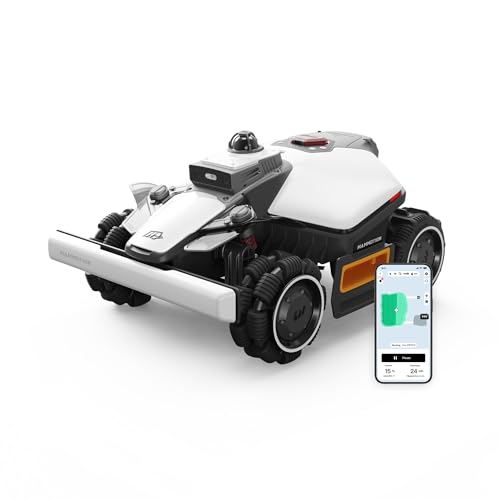
Mammotion LUBA mini 2 AWD 1500H Robot Lawn Mower with Garage
YARDCARE V100 Robot Lawn Mower HD Vision (Small Lawns)

ANTHBOT M5 Robot Lawn Mower 1/8 Acre with Garage

Segway Navimow i105N Robot Lawn Mower RTK+Vision (1/8 Acre)
The Strengths Of Each Pick
The YARDCARE V100 is the most approachable entry in this lineup, aimed squarely at suburban yards under 1,600 square feet. It uses a forward-facing HD camera paired with a bumper sensor to learn grass edges and dodge obstacles, which means no perimeter wire to bury on setup day. For a first-time owner who wants the mower out of the box and running within an afternoon, the appeal is real.
Where it sits best in this category is on flat, tidy lawns where its 150-object recognition library covers most garden gear, patio furniture, and pet toys. Compared with the Mammotion LUBA mini 2 AWD below, this model trades slope-grabbing traction for simpler controls, which most flat-lot shoppers will actually prefer.
The Good Stuff
- HD camera navigation skips the perimeter wire entirely, saving a full day of installation.
- Recognizes up to 150 object types, from sprinklers to garden hoses, so common yard clutter rarely derails a session.
- Compact footprint fits through 3-foot gates typical of small fenced backyards.
- Visual grass detection helps it avoid flower beds without manual no-go zones in many layouts.
Worth Noting
- Camera-based vision can struggle under heavy tree canopy where shadows confuse grass detection.
- Best suited to gentle, even terrain rather than steep or rutted ground.
- Owners commonly report needing to wipe the lens weekly during pollen season for reliable navigation.
Who Will Love This
First-time robot mower owners with a flat, open lawn under 1,600 square feet and minimal slope.
Look Elsewhere When
Your yard climbs past a 20 percent grade, where the Mammotion LUBA mini 2 AWD pulls ahead with true all-wheel drive traction.
The Mammotion LUBA mini 2 AWD 1500H is the muscle car of this roundup. It pairs 360-degree LiDAR (a laser-based scanning system that maps surroundings in real time) with dual AI cameras, giving it true all-around awareness rather than the forward-only view that simpler bots rely on. The included shelter-style garage keeps the body out of afternoon storms and morning dew, which extends deck life.
For shoppers whose lawns have personality, hills, multiple flower beds, and a half-acre footprint, this is the pick that finally earns its keep. Unlike the YARDCARE V100, which is happiest on a flat suburban patch, the LUBA mini 2 AWD is built to climb an 80 percent slope and manage up to 20 distinct mowing zones through the app.
A Favorable Mix
- All-wheel drive handles inclines where rear-wheel-only bots lose grip and leave uncut strips.
- Dual sensing redundancy means fewer collisions when one camera is briefly blinded by glare.
- Covers up to roughly 0.37 acres, which is a serious step up from the 1,600-square-foot class.
- Multi-zone management through the app handles front, back, and side yards as separate work areas.
- Included shelter garage shields the charging contacts and cutting deck from rain and UV wear.
Trade Offs
- Heavier chassis can leave faint tracks in very soft soil after repeated edge passes.
- Initial RTK (Real-Time Kinematic) base station placement takes careful planning for satellite lock.
- Premium feature set pushes it well above entry-level pricing for this category.
Quick Facts
Made For
Homeowners with hilly, multi-section yards up to a third of an acre who want serious slope and zone handling without going full commercial.
Consider Something Else When
Your lawn is a flat, sunny rectangle under 1,600 square feet, where the YARDCARE V100 delivers the same core job for far less.
This second YARDCARE V100 listing targets the same vision-driven platform as the first, but markets specifically toward compact-lot owners who measure their grass in square feet rather than acres. The HD camera does the heavy lifting for grass-versus-pavement detection, which matters in narrow side yards where boundaries are visually obvious but tricky for wheel-based sensors.
The honest read is that this is the same core mower aimed at townhouse courtyards and small fenced backyards. It shares the no-perimeter-wire setup that makes the V100 family appealing for renters who can’t trench their yard. If your patch is tight, shaded in spots, and roughly 1,500 square feet, this pick earns its place without the AWD premium.
Good Reasons To Consider
- Vision-based grass detection handles irregular lawn shapes common in older neighborhoods.
- No buried wire means easy setup for leased properties where digging isn’t allowed.
- Lightweight body keeps tire tracks faint on softer topsoil after evening cuts.
Small Caveats
- Heavy shade from mature trees can occasionally trip up the camera’s grass identification.
- Single-day battery run time may not finish very thick or damp grass on the first pass.
- Limited to roughly 1,600 square feet, so even slightly larger yards will need a manual finish.
Right Fit For
Renters, townhouse owners, and small-yard newcomers who want set-it-and-forget-it mowing without touching the lawn.
A Better Fit Elsewhere
You have rolling terrain or want true wire-free multi-zone control, in which case the Segway Navimow i105N steps up with RTK precision.
The ANTHBOT M5 is the tech-enthusiast pick in this roundup, layering full-band NRTK (Network Real-Time Kinematic, a satellite positioning method accurate to within a few centimeters) on top of a dual-vision system. That combination is meant to keep the mower cutting cleanly even when GPS signals bounce around tall buildings or tree lines, a common headache in older neighborhoods.
Where the Mammotion LUBA mini 2 AWD focuses on slope-climbing traction, the M5 focuses on positioning precision and multi-zone mapping through the app. The bundled garage again keeps the deck out of weather, and the 45 percent slope rating covers most residential grades without strain.
The Case For It
- Full-band NRTK plus dual cameras holds position under partial tree cover where single-system bots drift.
- Wire-free boundary setup via the app removes the trenching chore that turns off first-time shoppers.
- Adaptive cruise logic slows the bot near pets and wildlife rather than stopping abruptly.
- Multi-zone mapping handles front, back, and narrow side strips through the app interface.
A Few Limitations
- NRTK base station placement still matters; a poor rooftop or shed corner can reduce accuracy.
- App-driven setup has more learning curve than the camera-only YARDCARE V100 bots.
- Battery life assumes dry grass; very wet conditions may shorten usable runtime.
Feature Snapshot
Best Suited To
Hobbyist owners who enjoy tinkering with apps, mapping zones, and want positioning accuracy as good as premium GPS systems.
Skip It When
You’d rather plug in a charger and let the mower figure itself out, in which case the YARDCARE V100 keeps things simpler.
The Segway Navimow i105N rounds out the list with a strong case for noise-sensitive households. Its RTK+Vision hybrid positioning is similar to the ANTHBOT M5, but the headline number for many shoppers will be the 58 dB operating volume, which is closer to a quiet conversation than a traditional mower. Early-morning cuts without waking the neighbors become genuinely possible.
AI-assisted mapping sets this unit apart for tricky layouts. Narrow corridors between the house and a fence, oddly shaped garden islands, and irregular front lawns all benefit from the vision layer stepping in when satellite lock struggles. It’s the cleanest choice for suburban lots where boundary-wire trenching would have been a dealbreaker.
Reasons It Performs
- 58 dB operation keeps nighttime or early schedules realistic in close-set neighborhoods.
- AI-assisted mapping handles narrow passes and tree-shaded areas that confuse pure GPS bots.
- Wire-free virtual boundary is set up through the app in a single mapping walk.
- Multi-zone management keeps front and back yards on separate schedules.
Honest Caveats
- RTK positioning can still wander during severe solar storms or heavy rain, though the vision layer compensates.
- App interface requires a stable Wi-Fi signal at the dock for full remote control.
Perfect Match For
Suburban households with strict noise tolerance, odd-shaped lawns, or shared walls where quiet operation matters most.
Reach For A Different Pick When
Your yard climbs past a moderate grade, where the Mammotion LUBA mini 2 AWD’s all-wheel drive keeps the cut clean.
What To Weigh Before Choosing a Budget Robot Lawn Mower
Lawn size drives most decisions in this category. A 1,600-square-foot flat patch and a quarter-acre with two slopes need fundamentally different hardware, even if both technically count as “small.” Measure your grass and add 10 percent buffer for accuracy errors, then match that number to a mower’s published coverage.
Navigation type matters more than people expect. Camera-only systems like the YARDCARE V100 are affordable and easy to set up but can struggle under heavy canopy. RTK+Vision hybrids such as the Segway Navimow i105N and ANTHBOT M5 hold position better around trees and walls, but the base station placement adds a planning step.
Slope rating separates leisure mowers from real tools. Anything over 30 percent grade (roughly 17 degrees) starts to challenge standard two-wheel-drive units. AWD models like the Mammotion LUBA mini 2 climb closer to 40 degrees, which matters for hilly lots but is overkill for flat suburban yards.
Finally, think about app behavior and ecosystem. Some owners want a button-and-go experience with minimal phone involvement. Others enjoy tweaking zones, schedules, and cut heights from the couch. Both profiles are valid, and matching your comfort level to the mower’s complexity will determine whether the device feels like a helper or a hobby.
Smart Choices Across This Category
Pitfalls First Timers Hit
The most common mistake is buying by lawn size alone. A flat 1,500-square-foot yard and a sloped 1,500-square-foot yard require completely different hardware, and a coverage spec doesn’t tell you which slopes the mower can actually climb. Always cross-reference the lawn area with the slope rating before committing.
Another trap is assuming all “wire-free” mowers work the same way. Camera-only bots depend on good lighting and visible grass edges, while RTK-based units need a clear sky for satellite lock. If your yard sits under a heavy oak canopy, that difference matters more than the brand on the box.
Where The Extra Money Goes
Higher-tier models in this category earn their price through positioning redundancy. Dual sensing systems (laser plus camera, or RTK plus vision) keep the mower on course when one method fails, which translates to fewer stuck situations and more consistent stripes across the season.
Premium picks also tend to include weather protection, multi-zone app control, and better obstacle avoidance libraries. For most flat suburban lawns those are nice-to-haves. For uneven or complex yards, they shift from luxury to necessity, and that’s where spending up starts to pay off.
Frequently Asked Questions
How much lawn can a budget robot mower realistically cover?
Most sub-$1,000 models cover 1,500 to 1,600 square feet per charge, while mid-tier units stretch to roughly a third of an acre. Match the mower’s published coverage to your actual lawn size plus a 10 percent buffer.
Do robot mowers work on slopes?
Standard rear-wheel-drive bots handle gentle grades up to about 20 percent. For steeper hills, look for AWD (all-wheel drive) models rated for 45 percent slopes or higher, such as the Mammotion LUBA mini 2 AWD 1500H.
Can a robot mower replace a traditional mower entirely?
For small, regularly maintained lawns, yes. For tall, thick grass or overgrown lots, you may still need a string trimmer or push mower for the first session to bring the height down to a manageable level.
What maintenance does a robot mower need?
Blade replacement every one to three months during the cutting season, an occasional wipe-down of the camera lens or sensors, and clearing grass clippings from the deck and wheels. Battery care is mostly handled by the smart dock.
Are wire-free robot mowers reliable?
Newer RTK+Vision hybrids have largely solved the early positioning drift issues. They hold accuracy within a few centimeters in most residential conditions, though very dense tree cover can still challenge them occasionally.
The Takeaway
A good budget robot mower quietly removes one of the most tedious weekend chores, but only when its strengths line up with your lawn’s shape, slope, and sunlight. Match the mower to the yard first, and the rest of the decision gets much easier. If you’re still torn, the YARDCARE V100 is the safest starting point for flat small lawns, while the Segway Navimow i105N and Mammotion LUBA mini 2 AWD step in for trickier layouts.