A dead battery on a Saturday morning can turn a simple mow into a parts chase. I put this list together for anyone whose rider, garden tractor, or compact mower needs a dependable 12-volt replacement and who wants to match the right battery to the right machine without guesswork.
Your Options, Compared

WEIZE Lawn Garden AGM Battery 12V 300CCA BCI Group U1

WEIZE Lawn Garden AGM Battery 12V 200CCA BCI Group U1
TYKOOL 480CCA Group U1 Lithium LiFePO4 Lawn Mower Battery

WEIZE Lawn Garden AGM Battery 12V 350CCA BCI Group U1

ExpertPower EXP12120 12V 12Ah AGM Battery

Cole Hersee 24047 Intermittent Duty Solenoid

Mighty Max ML12-12 12V 12AH SLA Battery (Pack of 2)

Mighty Max ML18-12 12V 18AH AGM Battery
Meet The Standout Selections
Mid-size riders from John Deere, Cub Cadet, Craftsman, and Toro tend to land in the same battery bracket, and this WEIZE unit sits right in the middle of that group. The BCI Group U1 case measures roughly 7.68 by 5.12 by 6.22 inches, which matches the factory tray on most lawn tractors without shimming.
For someone mowing a half-acre to a full acre every week, 300 cold cranking amps (CCA, the current a battery can deliver at 0°F for 30 seconds) is usually enough headroom to start cold, even after a long winter sit. I see this as the safe middle pick when a shopper isn’t sure whether they need more power or less.
The Upside
- 300 CCA is a confident match for most single-cylinder and small twin-cylinder tractor engines.
- Sealed AGM (absorbed glass mat, a spill-resistant internal design) construction means no topping up water and safer transport in a tilted trunk.
- Left-side positive terminal layout matches the common U1 orientation used on John Deere, Toro, and Cub Cadet tractors.
- Around 18.7 pounds keeps the install simple enough for a one-person swap on the driveway.
Things To Consider
- Hazardous-materials shipping rules can extend delivery time in some regions.
- Not returnable, so measuring the tray and checking the terminal position before ordering matters more than usual.
Who It Suits Best
A homeowner with a typical riding mower who wants a straightforward, year-round replacement without overspending on capacity they will not use.
Look Elsewhere When
The TYKOOL 480CCA Lithium LiFePO4 battery makes more sense for anyone needing stronger cold-starting performance and a lighter pack.
Step down from the 300CCA version, and you land at 200CCA, which is plenty for a small push mower, a compact rider, or a yard tractor that lives in a mild climate. The case is the same Group U1 footprint, so the install is identical to the first pick on this list.
I would call this a careful, deliberate buy rather than a power buy. The honest read is that it covers the basics without inflating the cost for capacity a smaller engine cannot use.
Practical Pluses
- 200 CCA suits single-cylinder engines and light garden tractors in temperate zones.
- Same U1 dimensions as the rest of the WEIZE line, so a swap between models stays simple.
- Sealed AGM body resists vibration on bumpy lawns better than a flooded lead-acid cell.
Honest Caveats
- 200 CCA can feel thin on a cold morning north of zone 6, especially on a tractor that has been sitting for months.
- The 21.5-pound weight is slightly heavier than the 300CCA version, a small oddity worth knowing before lifting it into the tray.
Right Fit For
Owners of compact riders, rear-engine mowers, and small garden tractors who mow in spring-through-fall conditions and want a lower-spec replacement.
Consider Something Else When
The WEIZE 350CCA BCI Group U1 is the better match for anyone running a larger engine or pushing through harder cold-weather starts.
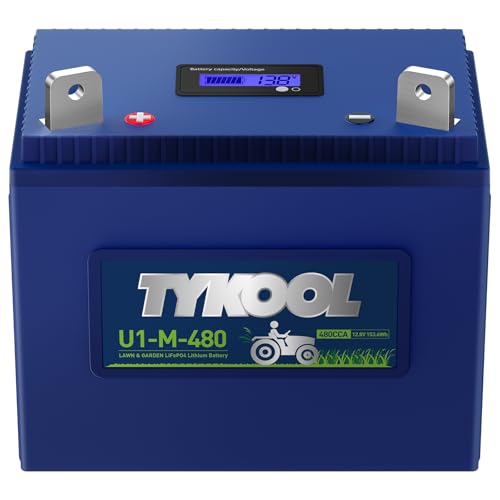
Here is where the list pivots from lead-acid to lithium. The TYKOOL uses LiFePO4 chemistry, a lithium iron phosphate formulation prized for stable voltage and a long cycle life, rated at 480 CCA. Compared to the WEIZE AGM units, it weighs a fraction as much and holds voltage more steadily under load.
For tractors that sit through freezing winters, the real win is the cold-cranking headroom. In my view, this is the most interesting battery on the list for cold-climate owners, and it is also the most expensive, which is why it lands at number three rather than number one.
Standout Benefits
- 480 CCA delivers a strong surge for stubborn engines on cold mornings.
- LiFePO4 chemistry is rated for thousands of charge cycles, far beyond typical AGM life.
- Lightweight build makes installing and removing the battery for winter storage much easier.
- Stable voltage output keeps headlights bright and consistent across the mow.
Practical Considerations
- Higher upfront cost than any lead-acid option on this list.
- Some older charging systems are not optimized for lithium and may need a quick voltage check before swapping.
Best Suited To
Riders and garden tractors that start in genuinely cold weather, plus owners planning to keep the same machine for many seasons and willing to pay up front for longer life.
A Better Fit Elsewhere
The WEIZE 350CCA AGM is a smarter pick for anyone on a tighter budget who just needs reliable cranking in mild weather.
The strongest lead-acid option from WEIZE on this list, this 350CCA battery targets bigger twin-cylinder engines and tractors that pull attachments like baggers or plows. Same U1 footprint, same terminal layout, just more cranking punch on tap.
For larger properties or any tractor that has to start a long winter nap and fire up the next spring without complaint, the extra 50 CCA over the 300CCA model is real headroom. You may find this is the safer buy when you do not want to second-guess a borderline-cold start.
The Value In It
- 350 CCA gives a comfortable margin for colder zones and infrequent use.
- Sealed AGM design handles vibration from rough ground and attached implements well.
- Drop-in replacement for the lower-spec WEIZE models in the same U1 case.
Points To Note
- Around 21.5 pounds, so it adds a bit of heft compared to the 300CCA version.
- Like the other WEIZE units, hazardous-materials shipping rules can affect delivery timing.
Who Should Grab It
Owners of larger garden tractors, machines with twin-cylinder engines, or anyone in a cold region who wants stronger cranking than a stock replacement offers.
Swap It Out When
The TYKOOL 480CCA lithium battery wins for anyone prioritizing weight savings and long cycle life over a familiar AGM form factor.
The ExpertPower EXP12120 is not a typical riding-mower battery, and that is the point. It is a 12V 12Ah sealed lead-acid pack with F2 spade terminals, sized more like a small alarm or mobility battery than a garden tractor battery.
For electric walk mowers, robotic mowers with small onboard packs, or even custom garden-tractor accessories, this fits where a Group U1 case would be far too large. It is a multi-role pick that solves a different problem than the rest of the list.
Noteworthy Benefits
- 12Ah capacity covers light electric mower needs and small backup applications.
- Sealed AGM construction works in any orientation without leaks.
- F2 terminals (a small flat-spade connector common on compact SLA batteries) make wiring accessory loads straightforward.
Trade Offs
- Not a Group U1 case, so it will not physically fit a standard riding-mower battery tray.
- CCA is not the main spec here; amp-hours matter more, and a gas rider needs cranking amps this battery does not provide.
Made For
Owners of small electric mowers, lawn-tractor accessory projects, or anyone needing a compact sealed 12V pack for a low-draw garden tool.
Not Your Match When
The WEIZE 300CCA U1 battery is the proper fit for a gas-powered rider or garden tractor that needs real cranking power.
This is the odd one out in the list, and I want to be upfront about that. The Cole Hersee 24047 is a starter solenoid, a heavy-duty electrical switch that engages the starter motor when you turn the key, not a battery at all. It shows up under the same lawn-tractor parts category, which is why it earns a spot.
For shoppers chasing a no-crank problem on a riding mower, the battery often takes the blame when the solenoid is the real culprit. This is the part to keep on the shelf if a starter click without an engine turnover is a familiar sound in the garage.
Key Advantages
- Intermittent-duty rating handles the high inrush of a starter motor on most lawn tractors.
- Standardized mounting footprint fits many OEM brackets with little fabrication.
- Compact size (about 6.5 inches long) makes routing wires under the hood easier.
Some Limits To Know
- Not a battery, so it cannot replace any of the other items on this list on its own.
- Intermittent duty means it is not built for continuous loads, like running a winch for extended periods.
Who Will Love This
Home mechanics diagnosing a no-start condition on a riding mower, or anyone who keeps a small stock of common replacement solenoids in the shed.
Where Another Pick Suits Better
The WEIZE 300CCA battery is the right starting point when the existing battery is simply old and no longer holding a charge.
A two-pack of 12V 12Ah SLA (sealed lead-acid) batteries with F2 terminals, this is another non-U1 entry on a list dominated by tractor batteries. The pairing makes sense for anyone running multiple small electric mowers, a fleet of robotic mowers, or a setup that wants a ready spare.
The honest read is that this is more about convenience and redundancy than about a single tractor’s needs. For a single riding mower, a Group U1 battery is the correct call, and you would not be here.
Where It Helps
- Two batteries in one purchase for backup or multi-tool setups.
- Sealed AGM (absorbed glass mat) design means maintenance-free storage on a shelf or in a shed.
- Calcium-alloy grid construction (a tougher internal plate alloy for longer cycle life) is rated for both float and cyclic use.
Possible Compromises
- No cranking amps rating shown for starter use, so this is not a tractor battery.
- F2 spade terminals need a matching connector or adapter for most mower wiring.
Whose Shelf It Belongs On
Owners of multiple small electric mowers, robotic mowers, or anyone who likes keeping a matched spare on hand.
Reach For A Different Pick When
The WEIZE 200CCA U1 battery is the right call for one gas rider that simply needs a fresh start in spring.
Closing out the list is the ML18-12 from Mighty Max, a 12V 18Ah sealed AGM battery with nut-and-bolt terminals. It shares the same calcium-alloy grid chemistry (a tough lead plate alloy for durability) as the smaller ML12-12 but delivers meaningfully more amp-hours, the measure of how long a battery can sustain a given current draw.
For any setup that drains a small 12V pack slowly, like a long-running accessory circuit or an off-grid lighting project, the extra 6Ah over the 12Ah pack is real runtime. For starting a gas rider, however, this is the wrong tool for the tray.
Positive Points
- 18Ah capacity extends runtime for accessory loads and small electric equipment.
- Nut-and-bolt terminals support heavier-gauge wiring and ring lugs (crimped cable ends that bolt onto the post).
- Sealed, valve-regulated AGM works indoors and in enclosed mower housings without venting.
Where It May Fall Short
- Not a Group U1 case, so it will not drop into a stock riding-mower battery tray.
- Heavier than the smaller Mighty Max 12Ah option, which matters for portable or robotic setups.
Built With In Mind
Hobbyists, off-grid garden lighting builders, and owners of custom electric mower projects who want higher capacity in a compact footprint.
Another Choice May Suit
The ExpertPower EXP12120 is the lighter, smaller alternative for projects where 12Ah is enough and weight matters more than runtime.
Getting The Right Fit For Your Mower
A 12-volt lawn-mower battery is not one-size-fits-all, and the wrong case or terminal layout can turn a quick swap into a frustrating afternoon. CCA (cold cranking amps) matters most for gas riders, while amp-hours matter more for electric mowers and accessory circuits. Group U1 is the standard case size for most riding tractors from John Deere, Cub Cadet, Craftsman, and Toro, so start by measuring the existing battery and confirming the terminal orientation.
Cold climate is the next big lever. In a region where winter means long sits and freezing starts, leaning toward 300CCA or higher, or stepping up to a lithium option like the TYKOOL, saves the headache of a no-start morning. For warm-season use, 200CCA is often plenty and trims the cost.
Terminal type is easy to overlook. Nut-and-bolt posts (often labeled “NB” or “J”) are common on tractor batteries, while smaller spade-style “F2” terminals show up on compact SLA packs for electric mowers and accessories. Confirm the post style against the existing cables before ordering, because adapters add cost and complexity.
Weight and shipping rules deserve a quick look too. Lead-acid batteries are heavy, and the WEIZE Group U1 units ship under hazardous-materials rules that can extend delivery windows. A lithium upgrade cuts the weight dramatically but raises the upfront spend. Matching the battery to how often the mower runs, and how cold the shed gets, usually lands the right answer.
Worth Knowing Before You Click
Pitfalls Shoppers Hit
The most common slip-up is buying a Group U1 battery for a mower that actually takes a smaller SLA pack, or vice versa. Measure the tray before anything else. Another trap is ignoring the terminal layout, positive on the left versus the right swaps cables around in confusing ways. For cold regions, undersizing CCA saves money up front but costs a tow or a service call the first hard freeze.
Where The Extra Money Goes
Spending more on a higher-CCA or lithium battery buys stronger cold-starting headroom, longer cycle life, and a noticeably lighter pack. For casual weekend mowers in mild climates, the jump is hard to justify. For frequent-use tractors or cold-climate storage, the upgrade often pays for itself in fewer replacements over the machine’s lifetime.
Frequently Asked Questions
How do I know which battery fits my mower?
Measure the existing battery tray, note the terminal layout, and check the owner’s manual for the group size. Group U1 is standard for most riding mowers.
What does CCA actually tell me?
CCA measures the current a battery can deliver at 0°F for 30 seconds while staying above a minimum voltage, which is why higher CCA helps in cold weather.
Can I use a lithium battery in an older mower?
Usually yes, but it is worth checking the charging system voltage, since some older tractors are calibrated for lead-acid and may overcharge a lithium pack.
How long does a lawn-mower battery typically last?
Three to five years is common for lead-acid AGM batteries with regular use, while LiFePO4 options often run significantly longer with proper care.
Is it safe to leave a battery in the mower over winter?
Most sealed AGM batteries handle a cold sit fine if kept fully charged, but a maintenance charger is a smart add for long winter storage.
The Takeaway
The right 12-volt battery comes down to case size, terminal type, and how hard the local climate pushes cold starts. Pick the Group U1 form factor for a gas rider, match the CCA to the weather, and the rest tends to fall into place.