Going electric for yard work used to mean compromises, but the battery-driven machines in this lineup change the conversation. Quiet enough for early mornings, clean enough to skip the gas station, and powerful enough to handle serious acreage. I pulled together seven options spanning remote-control slopes, robotic helpers, and full-size riding tractors so you can match the right tool to your lawn, your slope, and your weekend plans.
A Side-By-Side Look

Mowrator S1 4WD 18Ah Remote Control Lawn Mower, 21-Inch

TerraMow Replacement Blades for V600 & V1000
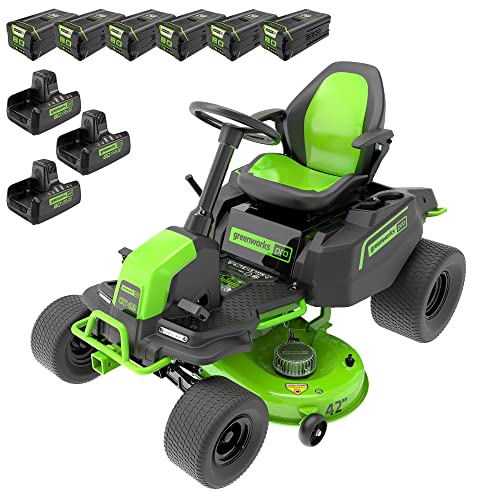
Greenworks PRO 80V 42″ Electric Lawn Tractor

TerraMow V1000 Robotic Lawn Mower, Auto Mapping
YARDCARE V100 Robot Lawn Mower for Small Lawns

Honda HRX-BE 21-Inch Battery Walk-Behind Mower

TerraMow V1000 Robotic Lawn Mower, 0.3 Acre
More Details On Our Top Picks
The Mowrator S1 stands apart from the rest of this list because you don’t actually sit on it, you steer it from a distance. That single feature changes who this machine makes sense for, namely anyone whose lawn punishes ordinary riders with sharp grades or uneven terrain.
Built around a 21-inch blade and a 37° slope rating, the S1 uses four-wheel drive and an 18Ah battery to climb where most riding mowers stall or slide. Remote operation also means you stay clear of dust, clippings, and steep drop-offs while the deck does the work.
Useful Touches
- Four-wheel drive grips slopes that leave standard riding tractors spinning.
- Remote control keeps your feet on solid ground during tricky hillside passes.
- 21-inch deck covers meaningful ground in fewer passes than push mowers.
- Year-round versatility with add-on snow plow and mulching attachments.
- Quieter than gas, so early-morning mowing won’t wake the neighborhood.
Worth Noting
- Remote mowing adds a learning curve and demands your full attention.
- Battery runtime caps how much ground you can finish per charge.
- Add-on attachments (snow plow, chains) push the total cost higher.
Feature Snapshot
Built With In Mind
Property owners with steep, uneven yards who want professional-grade cutting without riding a heavy tractor on a slope.
Skip It When
Flat-acreage owners will get more value from the Greenworks PRO 80V 42″ Electric Lawn Tractor, which covers wide open ground far faster.
This one’s a different category entirely, and that matters if you already own a TerraMow robot mower. The replacement blade bundle keeps your machine cutting cleanly through a full season without scrambling for spare parts mid-cycle.
Each pack ships with 12 high-carbon steel blades and 12 matching screws, organized into three sets of four. That generous count covers a season’s worth of blade swaps for the average robotic mower owner, and the high-carbon steel construction resists dulling better than generic replacements.
Everyday Perks
- 12 blades mean fewer reorders over the mowing season.
- High-carbon steel holds an edge through thick grass.
- Pre-matched screws save a hardware store trip.
- Three grouped sets make mid-season swaps quick and organized.
Things To Consider
- Only fits TerraMow V600 and V1000 models.
- Wearing protective gloves during swaps is strongly advised.
Made For
Current TerraMow V600 or V1000 owners who want a stockpile of fresh blades ready before the cutting season peaks.
Look Elsewhere When
Shoppers who don’t yet own a compatible robot mower should start with the TerraMow V1000 Robotic Lawn Mower further down this list.
The Greenworks PRO 80V sits in a different league from the robotic mowers earlier on this list, and it shows the moment you fire it up. This is a full riding tractor with a 42-inch deck, designed for homeowners who measure their lawn in acres rather than square feet.
The package bundles six 5.0Ah batteries and three dual-port turbo chargers, which Greenworks positions as enough cordless runtime to handle up to two acres per charge. The brushless motor architecture promises gas-like torque without the noise, fumes, or engine maintenance that comes with traditional tractors.
What Earns Its Place
- 42-inch deck finishes wide-open lawns in a fraction of the passes.
- Brushless motor delivers strong torque without engine upkeep.
- Six batteries plus three chargers minimize downtime between sessions.
- Quiet operation suits neighborhoods with early-morning mowing windows.
- No gas means no fuel storage, oil changes, or exhaust fumes.
Trade Offs
- Tractor footprint demands real storage space in a garage or shed.
- Battery charging logistics matter if you mow multiple acres back-to-back.
- Initial cost runs higher than the robotic options on this list.
Feature Snapshot
Whose Shelf It Belongs On
Homeowners with multi-acre, relatively flat properties who want riding-mower speed without gas-engine hassle.
Consider Something Else When
Hilly or compact yards pair better with the Mowrator S1 4WD 18Ah Remote Control Lawn Mower, which excels on steep terrain.
Where most robotic mowers cut with a handful of razor blades, the TerraMow V1000 ships with 36. That density translates into a finer, more even cut, especially on lawns that get mowed frequently throughout the growing season.
The auto-mapping feature relies on a triple-camera AI vision system, which sidesteps the boundary wire and RTK antenna setup that complicates other robotic installs. For someone replacing an aging robotic unit, the simpler onboarding matters almost as much as the cut quality.
Bright Spots
- 36 blades deliver a noticeably finer cut than typical four-blade robots.
- Triple-camera vision skips boundary wire installation entirely.
- No RTK dependency means fewer signal dropouts in tree-covered yards.
- Auto-mapping shortens setup time for first-time robotic owners.
Honest Caveats
- Camera-based navigation can struggle in heavy fog or very low light.
- More blades means more frequent replacement cycles across seasons.
- Best suited to lawns under the maximum coverage rating.
Who Should Grab It
Owners of mid-sized lawns who want a premium robotic experience and value fine cut quality over raw speed.
Reach For A Different Pick When
Anyone working with a much smaller lawn under 1,600 square feet may find the YARDCARE V100 Robot Lawn Mower a simpler, more affordable match.
The YARDCARE V100 exists for a specific kind of yard: the small, often oddly shaped lawn where dragging out a full mower feels like overkill. Up to 1,600 square feet of coverage puts it firmly in the city-lot and townhouse category.
HD vision navigation paired with a bumper sensor and AI object detection lets the V100 distinguish grass from pavement and avoid the kind of garden furniture, toys, and pet accessories that trip up less sophisticated robots.
Standout Benefits
- Compact footprint suits small urban and townhouse lawns.
- HD vision distinguishes grass from non-grass surfaces reliably.
- AI object detection helps avoid common yard obstacles.
- No boundary wire required for straightforward setup.
- Whisper-quiet operation won’t disturb close neighbors.
Room For Improvement
- Coverage ceiling rules out medium and large properties.
- Camera navigation depends on reasonable ambient lighting.
- Less suited to lawns with significant elevation changes.
Best Suited To
Urban homeowners with compact lawns under 1,600 square feet who want hands-off mowing without overpaying for acreage capability.
A Better Fit Elsewhere
Anyone managing a larger or more complex lawn will find the TerraMow V1000 Robotic Lawn Mower a smarter long-term match.
The Honda HRX-BE is the outlier on this list, and not because it’s a lesser product. It’s a walk-behind mower, which means hands-on mowing rather than sitting or stepping away. For many homeowners, that tradeoff is actually the point.
Honda engineered this battery model to deliver power and torque comparable to its gas GCV-series engines, with the 4-in-1 Versamow system handling mulching, bagging, discharging, and leaf shredding without extra attachments. The 21-inch deck and self-propelled design make it a serious tool for medium-sized lawns.
A Strong Showing
- Honda-grade motor delivers gas-comparable torque on battery power.
- 4-in-1 Versamow system swaps modes without extra tools.
- 21-inch deck covers meaningful ground per pass.
- Self-propelled drive reduces fatigue on larger yards.
- No gas, oil, or pull-cord starting simplifies routine use.
Minor Gripes
- Requires walking, which rules it out for shoppers seeking zero-effort mowing.
- Battery runtime limits very large properties.
- Higher price than basic electric walk-behinds.
Feature Snapshot
Perfect Match For
Homeowners who prefer the control and exercise of a walk-behind mower but want Honda engineering without gas-engine maintenance.
Where Another Pick Suits Better
Shoppers wanting truly hands-off mowing should consider the TerraMow V1000 Robotic Lawn Mower instead.
The TerraMow V1000 with the 0.3-acre rating is essentially the gentlest on-ramp into robotic mowing on this list. If the V1000 sibling earlier in this lineup felt like a step up, this version targets the homeowner who just wants the basics done well.
Setup takes about five minutes according to the manufacturer, with no boundary wire or RTK antenna to install. One-click auto-mapping handles the layout, and the AI vision system identifies obstacles and grass boundaries in real time.
A Few Highlights
- Five-minute setup removes the traditional robotic mower installation headache.
- Wire-free and RTK-free design works in more yard layouts.
- 0.3-acre coverage fits typical suburban lots comfortably.
- AI obstacle recognition reduces babysitting during operation.
Possible Compromises
- Coverage ceiling may limit larger properties.
- Performance depends on consistent ambient lighting for camera vision.
- Less heavy-duty than robotic mowers rated for bigger acreage.
Who It Suits Best
First-time robotic mower owners with suburban lawns under a third of an acre who want minimal setup and reliable daily mowing.
Not Your Match When
Owners with multi-zone or larger lawns will benefit more from the Greenworks PRO 80V 42″ Electric Lawn Tractor’s wide-deck speed.
What Matters Most Before Choosing Electric Riding Lawn Mowers
Cutting Deck Width vs. Lawn Size
Deck width determines how quickly a riding mower finishes the job. A 42-inch deck like the Greenworks PRO 80V 42″ Electric Lawn Tractor covers wide-open acreage fast, while smaller robotic units prioritize precision over raw speed. Match deck width to lawn size to avoid unnecessary passes or underwhelming coverage.
Battery Runtime and Charging Logistics
Battery runtime shapes your weekly mowing rhythm. Larger properties demand bigger battery banks, faster chargers, and a plan for keeping cells topped off between sessions. Robotic mowers sidestep this by returning to their dock automatically, but they still need consistent access to power.
Slope Handling and Terrain Capability
Not every lawn is flat, and not every mower climbs. The Mowrator S1 4WD 18Ah Remote Control Lawn Mower specifically targets steep grades, while most robotic units assume reasonably even ground. Slope rating should drive your pick as much as deck size if your yard has elevation changes.
Setup Complexity and Maintenance
Robotic mowers with wire-free, RTK-free setup save hours of installation compared to traditional boundary-wire models. Replacement parts like the TerraMow Replacement Blades for V600 & V1000 extend service life and keep cut quality consistent across seasons.
Key Considerations Across These Picks
Pitfalls Shoppers Hit
Buying a robotic mower rated for half an acre when your lot measures three-quarters leaves you recharging mid-mow, every time. Measure your lawn honestly before falling for coverage numbers. Same goes for slope: a flat-rated robot on a hillside becomes an expensive disappointment.
What The Upgrade Pays For
Higher-tier models like the Greenworks PRO 80V 42″ Electric Lawn Tractor justify their cost through wider decks, longer runtime, and brushless motor longevity. For properties over an acre, that upgrade trades weekend hours for a faster, cleaner finish. For smaller lots, a simpler robotic unit often delivers everything you actually need.
Frequently Asked Questions
How long do electric riding lawn mower batteries typically last on a single charge?
Runtime varies widely by model and workload, but most riding mowers in this category cover meaningful acreage on a full charge, while smaller robotic units trickle through their assigned zones over several hours.
Are electric riding mowers powerful enough for thick or tall grass?
Modern brushless motors match gas-engine torque for typical residential mowing, though very tall or wet grass can stress any electric drivetrain, so mowing frequency matters more than raw power.
Do robotic mowers really work without boundary wires?
Newer AI-vision systems like those in the TerraMow V1000 models use cameras and sensors instead of buried wires, which simplifies installation dramatically for first-time owners.
How much maintenance do electric riding mowers require compared to gas?
Electric drivetrains skip oil changes, spark plugs, and air filters entirely, leaving blade replacement, battery care, and occasional deck cleaning as the main routine tasks.
Can electric riding mowers handle wet grass?
Light morning dew is manageable, but mowing saturated lawns taxes any electric system and produces uneven cuts, so waiting for drier conditions remains the safer call.
Closing Thoughts
The right electric mower depends less on hype and more on your lawn’s actual shape, slope, and size. A small city lot asks for a compact robot. A hilly acre wants the remote-controlled climber. A wide-open property calls for a full riding tractor. Match the tool to the terrain, and the rest of the season tends to take care of itself.