Nothing derails a Saturday yard session quite like a mower that won’t turn over. A quality battery tender sits quietly on the bench through the off-season, sending a small, steady current that stops sulfation (the crystal buildup that kills lead-acid batteries) and keeps plates conditioned. Riders, push mowers with electric start, and even zero-turn owners all benefit when cold weather or long gaps between cuts threaten to flatten a battery. The right tender for you depends on the amp rating, battery chemistry, and whether you keep one machine or several on the property.
A Side-By-Side Look

Battery Tender Junior 12V, 750mA Charger and Maintainer (021-0123)

Battery Tender Plus 12V 1.25 AMP Charger and Maintainer
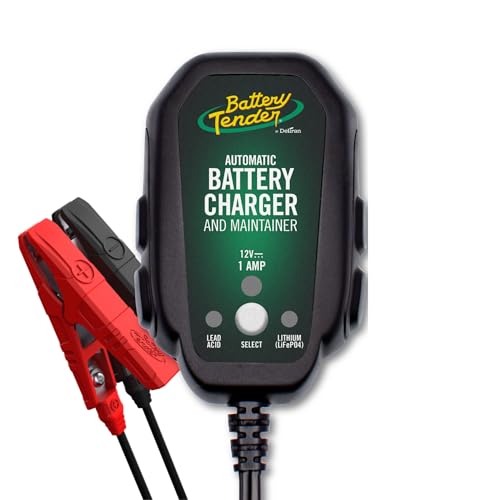
Battery Tender Junior 12V, 800mA Charger for Lead Acid and Lithium
Battery Tender 800 Waterproof Battery Charger (Encapsulated)
Battery Tender Plus 4-Bank Multibank Charger 5 AMP
Battery Tender 5 AMP 12V Battery Charger and Maintainer (022-0186G)

Battery Tender Plus 12V 1.25 AMP Battery Charger (022-0185G)
Battery Tender Plus 2-Bank Multibank Charger 2.5 AMP
Battery Tender 4 AMP Switchable 12V or 6V Charger (022-0209)
Battery Tender 3 AMP Switchable 12V or 6V Charger (022-0202)
More On The Choices That Made The List
The smallest unit in the lineup still covers the basic job that matters most: it feeds a 12V lawn tractor battery a slow, measured charge and then holds it at a safe float voltage. Owners of walk-behind mowers with electric start, or anyone storing a single rider in a garage over winter, find the 750mA output gentle enough that it never cooks a battery if left attached for months.
Compared to the Plus versions reviewed later, this unit lacks a quick-disconnect harness and ships with basic ring terminals. For most home yards, that’s a fair trade-off because the charger is small enough to toss in a drawer once spring arrives.
Features That Help
- Compatible with all 12V lead-acid, flooded, AGM, and gel cell batteries found in riding mowers.
- Four-step charging program that tops off the battery and settles into a maintenance float.
- Compact enough to live on a shelf next to the mower without eating floor space.
- Useful for motorcycles and ATVs during the off-season, doubling as a multi-vehicle tool.
Worth Noting
- The 750mA rate feels slow on larger U1-style batteries (a common lawn tractor size) that have been deeply discharged.
- Owners commonly mount it temporarily, since the housing is not weather-rated for outdoor placement.
Feature Snapshot
Made For
A homeowner storing a single riding mower through winter in a dry garage needs no more than steady, hands-off maintenance.
Skip It When
Owners running a small fleet of equipment should step up to the Battery Tender Plus 4-Bank Multibank Charger 5 AMP for parallel charging.
The Plus line nudges output to 1.25 amps, which is a sweet spot for most U1 group batteries that power average riding mowers. It uses adaptive smart charging that responds to the battery’s actual state rather than pushing a fixed current, which is helpful when a mower sat through a cold snap and the cells need a careful wake-up.
Where the Junior is a put-it-on-and-forget-it tool, this one comes with a quick-connect harness for the side of the battery. Hooking up takes seconds each season, which matters when the same tender moves between a mower, a generator, and a snowblower.
Positive Takeaways
- Adaptive algorithm adjusts current based on battery condition rather than running blind.
- 1.25A output revives lightly discharged batteries faster than the Junior.
- Quick-disconnect ring terminal lead makes seasonal swaps painless.
- Float-mode holding voltage prevents the sulfation buildup that ruins stored batteries.
Trade Offs
- Still not designed for outdoor mounting, so it needs a dry spot in a shed or garage.
- Lead-acid only, which limits owners who have moved to lithium-ion mower batteries.
Quick Facts
Whose Shelf It Belongs On
Riding mower owners with a standard flooded or AGM battery who want a fast, no-fuss maintenance setup.
Consider Something Else When
Anyone maintaining lithium-ion mower batteries will get more flexibility from the Battery Tender Junior 12V, 800mA Charger for Lead Acid and Lithium.
Switching between lead-acid and lithium chemistries with the push of a button is the headline feature here, and for mixed garages it earns its place. A mower running an AGM battery can share the same tender with a motorcycle that has been upgraded to LiFePO4 (lithium iron phosphate, a common lithium chemistry noted for stability), without buying two chargers.
The 800mA output is a small bump over the original Junior, which shaves time off a top-up without crossing into territory that could overwhelm a small battery. For shoppers stepping up from the entry-level Junior reviewed earlier, this is the natural pivot.
A Favorable Mix
- Push-button chemistry switching between lead-acid and LiFePO4 batteries.
- Slightly higher 800mA current reduces time to full charge.
- Microprocessor-based charging logic tailored to each chemistry.
Honest Caveats
- Switch must be set correctly before connecting, which is a small step that some owners forget.
- Single-bank design means swapping the tender between vehicles constantly.
Technical Highlights
Best Suited To
Yards with a lithium-equipped mower alongside older lead-acid equipment, where one charger can serve both.
Not Your Match When
Hobbyists with several vehicles to maintain at once will appreciate the simultaneous banks on the Battery Tender Plus 2-Bank Multibank Charger 2.5 AMP.
Most tenders ask to be kept dry, which is fine until your mower lives in a damp barn or open carport. The 800 Waterproof wraps its internals in electrical insulation, sealing the board against humidity and splash. For unheated outbuildings where condensation is a daily reality, that matters more than a small bump in amperage.
The form factor mirrors the Junior reviewed earlier, with the same 800mA rate. The big upgrade is the encapsulation (the entire circuit is sealed in a protective compound), and the unit also accepts a wide 100-240V input, which is convenient if a generator powers the shop.
Everyday Wins
- Sealed construction protects electronics in humid storage areas.
- Wide-voltage input supports use with portable generators.
- Fully automatic maintenance mode runs unattended.
Small Caveats
- 800mA charging is on the slow side for reviving deeply drained batteries.
- Encapsulation adds weight and bulk compared to a standard Junior.
Right Fit For
Anyone parking a mower in a barn, open shed, or covered porch where moisture sneaks in.
Look Elsewhere When
Shed space is dry and sealed, in which case the standard Battery Tender Junior 12V, 750mA Charger and Maintainer (021-0123) is the simpler pick.
Four independent charging channels at 1.25 amps each turn the chore of rotating one tender between vehicles into a non-event. Plug in the mower, the ATV, the generator, and the spare car all at once, and walk away. Each bank operates independently, so a fully charged battery stays in float while a depleted one keeps drawing current.
Compared to the single-bank Plus reviewed earlier, this unit trades portability for parallel coverage. It is overkill for a single-mower household, but a small property with multiple machines in winter storage gets exactly what it pays for.
What Makes Sense
- Four independent banks let mixed batteries charge simultaneously without crossover.
- 1.25A per bank matches the well-regarded Plus output profile.
- Switch from full charge to float automatically once each battery tops off.
- Supports standard, AGM, and lithium LiFePO4 chemistries across banks.
Less Ideal Details
- The enclosure is large and stays in one spot, so it isn’t portable to job sites.
- More cables to manage, which means routing them neatly takes some planning.
Who Will Love This
Property owners with a mower, tractor, and recreational vehicles all parked for winter want parallel charging without juggling adapters.
Where Another Pick Suits Better
One-machine owners will find the Battery Tender Plus 12V 1.25 AMP Charger and Maintainer a more focused tool.
Five amps is a serious step up from the maintainers in the rest of the list, and that shows up most clearly on larger batteries. A heavy zero-turn or a diesel-equipped compact tractor pulls the unit out of trickle territory and into genuine recovery work. The high-frequency switching design keeps the charger compact despite the heavier output.
Where this differs from the lower-amp Junior and Plus models is intent. It is sold as a charger first and a maintainer second. For a battery that has been neglected all winter and reads well below 12 volts on a meter, the extra current brings it back in hours rather than days.
The Helpful Details
- 5A output recovers deeply discharged batteries significantly faster than 1.25A maintainers.
- High-frequency switch-mode design (uses rapid electronic switching to shrink transformer size) keeps the unit compact.
- Four-stage charging covers qualification, bulk, absorption, and float.
- Works across lead-acid, AGM, gel, and lithium chemistries.
Practical Considerations
- Higher output means more heat under heavy load, so the unit needs ventilation around the housing.
- Overkill for a small push-mower battery that a Junior would handle.
Spec Overview
Who Should Grab It
Owners of larger riding mowers, zero-turns, and compact tractors with batteries that need real charging, not just maintenance.
Swap It Out When
A standard residential mower that simply needs winter float maintenance is well covered by the Battery Tender Junior 12V, 750mA Charger and Maintainer (021-0123).
This is a later revision of the Plus 1.25A maintainer, refined for stricter energy efficiency standards including the California CEC compliance rules. For shoppers in regulated states who care that their charger meets current efficiency benchmarks, that is the practical reason to choose this model number over its predecessor.
Performance-wise, it stays in the same lane as the earlier Plus: full charge, then float, with adaptive logic that watches battery voltage. For most mowing seasons it just sits on the battery quietly doing its job.
Useful Highlights
- Meets current California energy efficiency standards for chargers.
- Compatible with AGM and flooded 12V batteries.
- Advanced charging algorithms extend battery lifespan during storage.
Points To Note
- Lead-acid chemistry only, with no lithium switch.
- Charging speed is moderate, similar to other 1.25A Plus units.
Built With In Mind
Homeowners in California or other regulated markets who want a compliant, dependable maintainer for a standard riding mower.
A Better Fit Elsewhere
Anyone with a lithium-equipped machine should pick the Battery Tender Junior 12V, 800mA Charger for Lead Acid and Lithium instead.
Two banks deliver 1.25 amps each, which is the middle ground for homeowners who need to maintain a mower alongside a second vehicle but do not have a full fleet. The enclosure runs cool and quiet, and each channel handles flooded, sealed maintenance-free, and AGM lead-acid chemistries.
Versus the four-bank sibling reviewed above, this one is friendlier to smaller shops and tighter benches. For an apartment dweller storing a mower and a scooter, the math works out cleanly.
Strengths Worth Knowing
- Independent 1.25A banks serve two batteries without manual switching.
- Supports flooded, sealed, AGM, and lead-acid types.
- Compact footprint fits narrow shelves or workbench edges.
Things To Consider
- Not weather-rated, so it needs a dry mounting spot.
- Limited to lead-acid chemistries, with no lithium profile.
Who It Suits Best
Mower owners who also maintain one extra vehicle, like a motorcycle or compact tractor, in the same garage.
Reach For A Different Pick When
Lithium-ion batteries are in the mix, in which case the Battery Tender Junior 12V, 800mA Charger for Lead Acid and Lithium is a better chemistry match.
Older riding mowers and many classic garden tractors used 6V batteries, and chasing the right charger for them is annoying when the rest of the shed is 12V. This unit toggles between the two at the push of a button, while still pushing 4 amps for faster recovery than the standard Plus line.
The integrated smart controller watches for voltage drop under load and resumes full output when needed. For owners restoring a vintage mower or maintaining a mixed-voltage collection, that automatic behavior removes one more thing to babysit.
A Few Highlights
- Switchable between 12V and 6V for legacy mower batteries.
- 4A output offers meaningful recovery speed.
- Adaptive charging resumes after voltage drops under load.
- Compatible with lead-acid, AGM, gel, and lithium chemistries.
A Few Limitations
- 6V batteries are increasingly rare, so the switch may go unused for years.
- The fan-cooled enclosure runs slightly louder under heavy load.
Perfect Match For
Vintage mower collectors and anyone maintaining a 6V battery alongside modern equipment.
Another Choice May Suit
Homeowners running only modern 12V mowers will get simpler operation from the Battery Tender Plus 12V 1.25 AMP Charger and Maintainer.
Three amps sits between the maintenance-focused Plus units and the recovery-focused 5A model. The 11-foot combined cord length, which pairs a 6-foot AC line with a 5-foot DC output, matters more than it sounds: tucked-away mower bays and corner outlets become much easier to reach without an extension cord.
The two-color LED indicator takes the guesswork out of charge state, and the switchable 6V or 12V output covers the same vintage battery use cases as the 4A model above, just with a slightly slower charge rate.
Notable Gains
- Switchable between 6V and 12V systems in one unit.
- 11-foot combined cord reach handles awkward outlet placement.
- Two-color LED clearly communicates charging state.
- Adaptive charging resumes output when battery voltage dips.
- Works across lead-acid, AGM, gel, and lithium chemistries.
Points To Keep In Mind
- 3A output is moderate, slower than the 5A charger for deeply discharged batteries.
- Not weather-rated, so it should stay indoors or in an enclosed shed.
Who Should Grab It
Garage layouts with limited outlet access and a mix of battery voltages benefit most from the long reach and dual-voltage support.
Skip It When
Heavy zero-turns and large compact tractors charge faster on the Battery Tender 5 AMP 12V Battery Charger and Maintainer (022-0186G).
What To Weigh Before Picking A Lawn Mower Battery Tender
Match The Output To The Battery Size
A small push mower with a 10 to 15 amp-hour battery gets along fine on a 750mA or 800mA tender, which tops it up slowly without risking damage. Larger riding mowers and zero-turns with group U1 batteries closer to 30 to 50 amp-hours recover faster on a 1.25A or higher unit. Going too small is harmless but slow; going too large risks shortening battery life if the charger does not step down properly into float mode.
Decide Between Maintenance And Recovery
If the goal is to keep a healthy battery topped off through winter storage, a 750mA to 1.25A maintainer is the right tool. If the battery tends to run flat before spring and needs a real recharge, the 4A or 5A units reviewed here shorten that recovery time dramatically. For most households, a quality maintainer is enough.
Check The Chemistry
Lead-acid in flooded, AGM, or gel form covers the vast majority of mower batteries on the road. Lithium iron phosphate batteries are appearing in newer premium mowers and need a charger with an explicit lithium profile. Mismatched chargers can damage lithium cells, so the switchable units reviewed above earn their place in mixed garages.
Think About Storage Conditions
An indoor garage with stable temperatures works for any unit on this list. Damp barns, open sheds, and unheated outbuildings benefit from sealed or encapsulated models, like the waterproof 800mA unit reviewed earlier. Cord length also matters if the nearest outlet is on the far wall of a long shed.
Smart Habits And Where The Extra Dollars Go
Common Shopping Slip Ups
The most frequent mistake is buying a basic trickle charger (a charger that delivers a constant low current with no automatic shut-off) and expecting it to maintain a battery indefinitely. Trickle chargers never step down, so they slowly cook a battery over months of storage. Smart tenders with float mode solve this. Another trap is assuming all lawn mower batteries are 12V; vintage tractors and some older riding mowers run on 6V systems, and a mismatched charger can destroy a battery in hours.
Where The Extra Money Goes
Higher-tier models earn their price through faster recovery amperage, multi-bank designs, sealed weatherproof construction, and dual-voltage switching. For most residential users, a midrange Plus-style unit covers the job well. The upgrade to a 4A or 5A unit pays off when batteries are routinely left discharged, or when the equipment list grows beyond a single mower.
Frequently Asked Questions
How long can a battery tender stay connected to a lawn mower battery?
Quality tenders with float mode can stay connected indefinitely, which is the whole point. The charger tops off the battery, then drops to a maintenance voltage that offsets normal self-discharge. Owners commonly leave them attached for the entire off-season without issue.
Will a battery tender revive a battery that is completely dead?
Sometimes, though it depends on why the battery died. A tender can slowly bring a sulfated battery back if the plates are not permanently damaged, but a battery that reads under 10 volts may not recover at all. In that case, replacement is usually the better path.
Can a car battery tender work on a lawn mower battery?
Most 12V tenders handle both, since riding mowers and cars share the same nominal voltage. The amperage rating of the tender should match the battery size. A 5A automotive charger is fine on a large mower battery, but a tiny motorcycle-sized maintainer on a deep-discharged U1 battery will take days to recover.
Do lithium mower batteries need a special tender?
Yes. Lithium iron phosphate cells use different voltage thresholds than lead-acid, and a charger without an explicit lithium profile can overcharge or damage them. The switchable units reviewed here handle both chemistries safely when set correctly.
Is it safe to leave a battery tender on outdoors?
Only if the tender itself is rated for outdoor use. Standard indoor units should be kept in a dry location, even when the battery is in an open shed. Moisture can damage the charger’s electronics regardless of how well the battery is sealed.
Closing Thoughts
A battery tender is one of those quiet tools that pays for itself by preventing a single failed start on a busy Saturday. Match the output and chemistry to the mower, pick a sealed model if the storage spot is damp, and step up to a multi-bank unit when the equipment list grows. Any of the picks above will do the job well when sized correctly to the battery it sits on.