I put this roundup together for anyone staring down a sprawling lawn and wondering whether a robot can really handle the work. Commercial robot lawn mowers have grown up fast, and the current crop navigates with vision systems, climbs serious slopes, and parks itself when the battery dips. The picks below cover everything from small yard specialists to four-wheel-drive machines built for acreage, so you can match the right mower to the property you actually own.
The Main Contenders
YARDCARE V100 Robot Lawn Mower HD Vision 1600 sq ft

Mammotion LUBA 2 AWD 5000HX Robot Lawn Mower

Mammotion LUBA 2 AWD 3000X Robot Lawn Mower
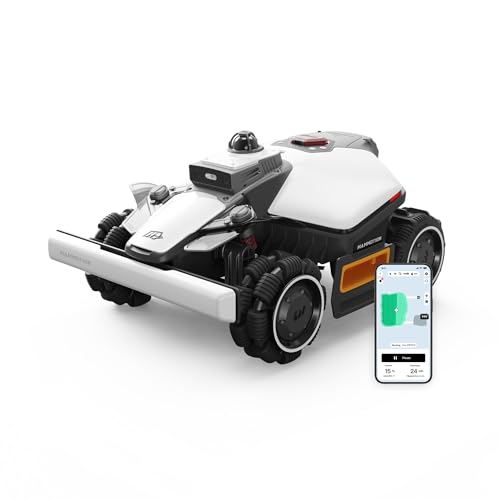
Mammotion LUBA mini 2 AWD 1500H Robot Lawn Mower

Mammotion LUBA 2 AWD 3000HX Robot Lawn Mower
YARDCARE V100 Robot Lawn Mower HD Vision

YARDCARE M800Plus Robot Lawn Mower GPS 3D Vision

ANTHBOT M5 Robot Lawn Mower Dual Vision RTK
The Strengths Of Each Pick
The YARDCARE V100 sits in that comfortable middle ground where the lawn is too big for a push mower’s appeal on weekends, but too small to justify a commercial rig. It relies on a camera-based navigation system (a visual sensor paired with a bumper) to recognize grass from non-grass surfaces, and it claims the ability to identify up to around 150 different obstacle types.
Compared to the bigger LUBA machines further down this list, the V100 keeps things deliberately modest. That makes it approachable for a first-time owner who does not want to learn RTK base stations on day one.
A Strong Showing
- HD visual navigation reads the layout directly, so there is no boundary wire to bury before the first run.
- The integrated bumper sensor recovers gracefully when something slips past the camera’s field of view.
- Compact footprint suits narrow side yards and townhouse plots up to roughly 1600 square feet.
- NO-GO zone controls let you block off flower beds without rerouting any wire.
Honest Caveats
- Best results require clear visual boundaries between grass and surrounding surfaces.
- Slope rating is conservative compared to the four-wheel-drive Mammotion models.
Who It Suits Best
First-time owners with a tidy suburban lot under 1600 square feet who want a set-it-and-forget-it weekend helper.
Look Elsewhere When
Properties with steep grades or extensive acreage should reach for the Mammotion LUBA 2 AWD 5000HX instead.
This is the flagship of the LUBA lineup and it shows in the specifications. The 5000HX carries the same four-wheel-drive chassis seen across the family, paired with UltraSense AI Vision and RTK (Real-Time Kinematic) positioning, which is a satellite-based system that delivers centimeter-level accuracy when a compatible base station is installed.
Where the YARDCARE V100 stays polite about slopes, the LUBA 2 AWD 5000HX claims it can climb grades up to around 80 percent. That puts it in the same conversation as machines used on golf-course edges.
The Good Stuff
- All-wheel-drive traction handles rough ground, deep ruts, and thick grass without getting bogged down.
- Reception coverage extends across roughly 1.25 acres, with a maximum working area around 1.48 acres.
- RTK mapping with auto edge recognition trims borders cleanly, reducing the need for a follow-up string trim.
- Adjustable cutting height between 2.2 and 4.0 inches covers most turf preferences.
- 4G connectivity allows schedule tweaks from anywhere with cell coverage.
Points To Note
- RTK setup requires a clear sky view and some patience with the reference station placement.
- Power and capability come at a price tier well above the smaller picks on this list.
- Overkill for lots under a quarter acre.
Feature Card
Made For
Owners with multi-acre properties, hilly terrain, and a willingness to invest in serious automation.
Consider Something Else When
Anyone managing a compact lot under a third of an acre will find the Mammotion LUBA mini 2 AWD 1500H more proportionate.
The 3000X trims coverage down to roughly three-quarters of an acre while keeping the same four-wheel-drive DNA as the flagship. For homeowners whose yards feel too big for a simple perimeter-wire bot but too modest for the 5000HX, this version threads the needle.
It arrives with a charging station, an extra set of blades, and the RTK installation kit included, so the first-day setup stays in one box. That’s a quieter convenience than it sounds.
Everyday Wins
- All-wheel-drive chassis climbs grades up to 80 percent without slipping on damp turf.
- Coverage target of 0.75 acre suits typical suburban lots with rear gardens.
- 4G connectivity enables schedule tweaks without walking to the unit.
- Extra blade set in the box reduces first-season maintenance shopping.
Softer Spots
- Still requires the RTK reference station to reach its full accuracy.
- Battery runs shorter per cycle than the 5000HX, so larger lawns need longer total runtime.
Best Suited To
Owners with hilly, three-quarter-acre lawns who want flagship traction without paying for acreage they don’t have.
Skip It When
Flat urban lawns will be over-served here, and the YARDCARE M800Plus is a more proportionate pick.
The mini variant shrinks the LUBA idea down to roughly 0.37 acres, and it does so by stacking LiDAR (a laser-based depth sensor that spins to build a 3D map of its surroundings) on top of dual cameras. That’s a useful belt-and-suspenders approach when fences, toys, and garden hoses crowd the lawn.
It also ships with a dedicated garage, which is the small touch that keeps the unit out of the rain. For homeowners tired of seeing their robot sit on the dock like a small ship, that detail matters.
The Helpful Details
- 360° LiDAR sweeps in a 45° vertical field of view, catching low obstacles the camera might miss.
- Dual-camera redundancy speeds up object recognition so the bot pauses less often.
- Twenty-zone management handles front, side, and back yards as separate mowing tasks.
- DropMow function lets it work on curved or awkwardly shaped patches.
- All-wheel-drive keeps it planted on slopes up to about 80 percent.
Some Limits To Know
- Smaller battery means more frequent dock returns on bigger jobs.
- LiDAR turrets can sit higher than the body, so very narrow side gates may be a squeeze.
Quick Facts
Whose Shelf It Belongs On
Homeowners with complex, multi-zone lawns under roughly a third of an acre who want flagship sensing in a smaller package.
A Better Fit Elsewhere
Anyone tending a flat, rectangular city lawn can save money with the YARDCARE V100 instead.
The 3000HX is the HX-series sibling to the 3000X reviewed just above. The big difference shows up in the boundary system. This version goes perimeter-wire free, leaning entirely on UltraSense AI Vision and RTK auto-mapping to figure out where to mow.
For anyone who has ever tried to trench a wire around a curving flower bed, that simplification alone is worth a hard look.
Positive Points
- No boundary wire means weekend installation doesn’t turn into a trenching project.
- UltraSense AI Vision pairs with RTK for clean edge-following on irregular lawns.
- Adjustable cutting deck between 2.2 and 4.0 inches covers most turf types.
- All-wheel-drive traction handles slopes up to about 80 percent.
Worth Bearing In Mind
- RTK reference placement still needs a clear view of the sky.
- Works best with clearly defined lawn edges for the vision system to read.
Feature Snapshot
Right Fit For
Homeowners mid-sized lawns who want flagship traction without burying any boundary wire on installation day.
Another Choice May Suit
Owners with smaller lawns and tighter budgets will be happier with the YARDCARE M800Plus.
This is the second V100 listing on the list, and it reads like a tidy, beginner-oriented alternative to the flagship version. The core idea stays the same: an HD camera reads grass boundaries, a bumper sensor handles surprises, and the unit avoids the trenching that older robot mowers required.
For first-timers easing into automation, the learning curve here is genuinely short.
Positive Takeaways
- HD visual navigation removes the boundary-wire step most legacy robots still demand.
- Bumper sensor recovery handles blind-spot collisions without locking up.
- 1600-square-foot ceiling matches typical starter-home yards.
- NO-GO zones let owners block off planting beds without rerouting.
Less Ideal Details
- Camera reads work best when grass edges contrast with the surrounding surface.
- Not the right tool for big yards or steep grades.
Perfect Match For
First-time robot mower owners with modest lawns who want a low-fuss introduction before scaling up.
Where A Sibling Pick Shines
Yards with curving beds and obstacles will be handled more reliably by the YARDCARE M800Plus.
The M800Plus jumps in size from the V100 and brings GPS plus 3D vision into the mix. It’s also the first pick on this list that uses a magnetic stripe rather than relying purely on a vision map, which is a small but useful backup if weather or shadows confuse the cameras.
For sub-acre lawns where owners want richer features without stepping up to a full RTK rig, the M800Plus is a reasonable middle stop.
The Practical Payoff
- GPS and 3D vision combine for reliable grass-versus-non-grass recognition.
- 32.8-foot magnetic stripe gives an extra boundary signal when vision is uncertain.
- App control handles scheduling, zones, and no-go areas from a phone.
- Bow-shaped mowing pattern covers ground efficiently rather than wandering randomly.
- Coverage extends up to about 8611 square feet, suited to larger suburban lots.
Where It May Fall Short
- Manufacturer recommends a manual trim if grass exceeds 2.6 inches before the first run.
- Magnetic stripe installation takes an extra planning pass before the bot can roam.
Technical Highlights
Who Will Love This
Suburban owners with visually defined lawns around a quarter acre who want richer navigation without RTK complexity.
Reach For A Different Pick When
Properties with steeper grades or bigger acreage will be better served by the Mammotion LUBA 2 AWD 3000X.
The ANTHBOT M5 rounds out the list with a clever dual-vision approach combined with full-band RTK positioning. Adaptive Cruise Control helps the bot slow down when something crosses its path rather than slamming on the virtual brakes.
Coverage tops out around an eighth of an acre, which puts the M5 in city-lot territory. Where it earns its keep is precision on lawns with lots of small features.
Useful Strengths
- Full-band RTK positioning keeps the bot on track even when tree canopy interferes with the satellite signal.
- Dual-vision system reads lawn edges with centimeter-grade accuracy.
- Adaptive Cruise Control smooths starts and stops around moving obstacles.
- Multi-zone mapping handles up to several separated lawn patches.
- App control keeps scheduling and adjustments in one place.
Honest Caveats
- Slope handling is rated around 45 percent, lower than the four-wheel-drive Mammotion units.
- Best suited to small, defined lawns rather than sprawling acreage.
Built With In Mind
City homeowners with intricately shaped lawns and narrow corridors who value precision over raw coverage.
Swap It Out When
Properties with steeper grades or a full quarter-acre of turf should look at the Mammotion LUBA mini 2 AWD 1500H.
What To Weigh Before Choosing Commercial Robot Lawn Mowers
Coverage And Lawn Size
Start with the size of the lawn measured in square feet or acres. Anything under roughly 1600 square feet can be handled by vision-only bots like the YARDCARE V100. Once you cross a quarter acre, RTK positioning becomes worth the extra setup because it keeps the mower on a clean path even when trees or buildings interfere with satellite signals.
Slope And Terrain
Slope ratings are the easiest spec to misread. A claim of 80 percent slope means the mower can handle a rise of nearly 38 degrees, and only four-wheel-drive chassis like the LUBA family consistently manage that. For flat suburban lots, a two-wheel-drive model will feel plenty capable and cost less.
Boundary Method
Older robots required a buried perimeter wire, which is the kind of weekend project people regret. Modern units use one of three approaches: cameras only, RTK plus cameras, or magnetic stripes. Cameras work well on lawns with clear visual edges. RTK shines on irregular layouts. Magnetic stripes act as a backup signal when lighting or weather throws the camera off.
Maintenance And Ownership
Blade replacement, deck cleaning, and software updates all show up in the first year. Units that ship with a spare blade set, like the LUBA 2 AWD 3000X, save a small but real amount of hassle. Storage matters too. A garage or covered dock keeps electronics out of the rain and extends service life.
Key Considerations Across These Picks
Common Shopping Slip Ups
One mistake I see often is buying more mower than the lawn actually needs. A four-wheel-drive RTK rig on a flat 1500-square-foot lot is overkill, and the extra capability rarely pays off. On the flip side, choosing a vision-only bot for a hilly half-acre usually leads to frustration when the unit slips off contours or misses edges.
What The Higher Tier Buys
The premium picks on this list add RTK positioning, four-wheel-drive traction, and 4G connectivity. For large or hilly lawns, RTK alone can justify the step up because it removes the wandering pattern that cheaper bots fall into. Owners with modest, flat lawns usually get more value from a mid-tier model like the YARDCARE M800Plus.
Frequently Asked Questions
Do commercial robot lawn mowers really handle steep slopes?
The four-wheel-drive models in this roundup, particularly the LUBA 2 AWD series, claim to climb grades up to about 80 percent. Flat-lot models like the ANTHBOT M5 top out closer to 45 percent, so matching the slope rating to the actual yard is worth the few minutes of measuring.
Is RTK positioning worth the extra setup?
For lawns larger than a quarter acre or those with curving borders, RTK positioning delivers noticeably cleaner cuts and tighter edges. On small rectangular lawns, the difference is harder to see, and a vision-only bot will get the job done.
How much lawn care do these robots replace?
They handle routine mowing on a schedule, which is the most time-consuming part of lawn upkeep. Edging along fences, fertilizing, and seasonal cleanups still fall to the owner, but the weekly mowing disappears from the calendar.
Can these mowers work in the rain?
Most commercial robot lawn mowers are designed to return to their dock when rain starts and resume once the grass dries. Mowing wet turf isn’t recommended because clippings clump and the cut looks uneven.
What about security and theft?
Higher-tier units with 4G connectivity allow GPS tracking and remote lock, which discourages casual theft. Smaller bots without connectivity rely more on physical security, so storing them in a garage or behind a fence is the practical move.
Closing Remarks
I’ve aimed this roundup at readers who want a robot that genuinely replaces the weekly mow rather than just toys with the edges. Match the mower’s coverage and slope rating to the lawn you actually own, and pay attention to the boundary method because it shapes the first-day setup more than any other spec. Take your time comparing the picks above, and the right match for your property should jump out once you line up the numbers.