A patchy, compacted lawn rarely fixes itself. Water beads on the surface, roots stay shallow, and fertilizer seems to vanish without doing much. Home lawn aerators solve that problem by punching channels into the soil so air, moisture, and nutrients reach the root zone where they actually count. Whether you tend a small yard or a sprawling half-acre, the right manual aerator turns an afternoon chore into genuine lawn recovery.
The Shortlist At A Glance
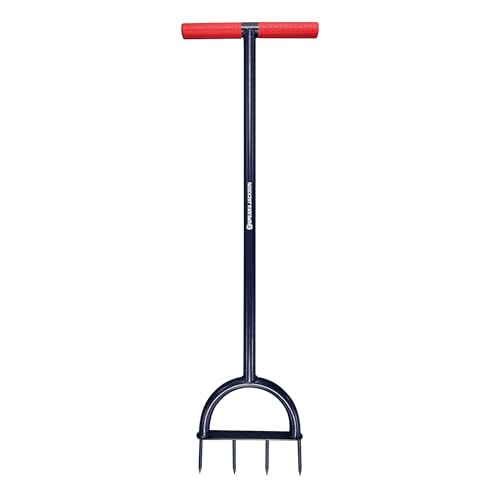
Spear & Jackson 4852LSA Lawn Spike Aerator (All-Metal)

Lawn Aerator Shoes for Compacted Clay Soil

RAEOHE Manual Core Aerator with 4 Hollow Tines

Seeutek 40-Inch Tow-Behind Spike Aerator

Seeutek 18-Inch Push Spike Aerator

Bluesea 16-Iron Spike Lawn Aerator (Orange)

Bluesea 16-Iron Spike Lawn Aerator (Green)
What Each Pick Brings To The Table
This is the pick for anyone who treats lawn tools like long-term investments rather than seasonal throwaways. The all-metal body, carbon steel spike head, and wide T-handle with a non-slip grip feel substantial the moment you pick it up, and the integrated footrest makes driving those spikes into compacted soil noticeably easier than stepping on a flimsy crossbar.
For small to mid-sized lawns with light compaction, this Spear & Jackson aerator punches in cleanly without the bending fatigue of cheaper alternatives. The brand heritage in garden tools tends to translate into parts that don’t loosen after a season.
The Case For It
- Carbon steel spikes penetrate compacted soil with minimal effort from your body.
- Non-slip T-handle keeps wrists comfortable during longer sessions, which matters more than people expect.
- Wide footrest gives a stable platform so you can lean your full weight in.
- All-metal construction generally outlasts plastic-bodied competitors, especially when stored outdoors.
Things To Consider
- Spike aerators don’t remove soil plugs, so they work best as a maintenance tool rather than a rescue tool for severely compacted turf.
- The all-metal body is heavier, which can tire out casual users working large lots.
- Rinsing and drying the spikes after use helps prevent rust, a small but real ownership step.
Feature Snapshot
Right Fit For
Homeowners with small lawns who want a sturdy, low-tech tool they can pull out two or three times a year without thinking about it.
Swap It Out When
If your lawn is large and your soil is heavy clay, the onoxouo Lawn Aerator Shoes let you cover ground faster while walking the dog or mowing.
Strap-on aerator shoes make sense the moment your lawn is bigger than a putting green but smaller than a pasture. You just lace them over your work boots and walk your normal routes: the spikes dig in with every step. The thickened 5mm metal base here is roughly 70% thicker than what you’ll find on many budget pairs, and the wider footrest area adds stability.
For anyone with stubborn clay, the trade-off is effort. You’ll feel it in your calves the first afternoon, but the depth you get out of each step is genuinely useful. Owners commonly find the strap system takes a few tries to dial in before the shoes stop shifting mid-walk.
Useful Strengths
- Walking-based use means you’re aerating while doing other yard tasks, no extra workout required.
- Heavy-duty 5mm base plate handles downward force without flexing, which matters on dense clay.
- Adjustable straps fit a wide range of work boots and sneaker sizes.
- Stores flat in a shed, taking up far less room than any rolling aerator.
Worth Noting
- The learning curve on foot placement is real, early sessions can leave patchy spike patterns.
- Straps need periodic retightening; owners report they can loosen after a long stride.
- Walking compacted clay for an hour is harder on the legs than people assume going in.
Feature Card
Best Suited To
Walkers and multitaskers with mid-size yards who want aeration woven into a normal stroll rather than treated as a separate chore.
Where Another Pick Suits Better
For very large lawns where walking becomes impractical, the Seeutek 40-Inch Tow-Behind Spike Aerator hooks to a riding mower and finishes the job in a fraction of the time.
Spike aerators push soil aside. Core aerators pull plugs out, and that difference matters when your lawn actually needs help. The RAEOHE tool uses four hollow tines that sink up to 3.94 inches into the ground and remove small soil cores with each step, opening real channels for air and water.
A side-opening design is built to reduce clogging, so you’re not stopping every few plunges to clear stuck plugs. Compared to the Spear & Jackson spike aerator above, this is the deeper, more therapeutic option for serious compaction. For cool-season grass like fescue or Kentucky bluegrass that thrives on fall aeration, the depth advantage pays off.
Real Benefits
- Removes actual soil plugs instead of just compressing dirt sideways.
- 3.94-inch depth reaches the root zone where spike tools often fall short.
- Side-opening tines clear plugs without disassembly, saving real time on the job.
- Encourages overseeding success because seeds drop directly into the holes.
Trade Offs
- Plug aerators leave visible soil cores on the lawn that need to be left alone or broken up.
- Wet conditions can clog even anti-clog designs, so timing around dry days helps.
- Manual core aeration is slow on big lawns; more than a few thousand square feet gets tiring.
Spec Overview
Whose Shelf It Belongs On
Detail-oriented homeowners planning a fall overseeding or recovery program who want genuine soil relief rather than surface-level poking.
Look Elsewhere When
If you’d rather treat aeration as a passive add-on to mowing, the Seeutek 18-Inch Push Spike Aerator rolls across the lawn on wheels without any pulling motion.
Past a certain lawn size, manual aerators stop being realistic. The Seeutek tow-behind unit solves that by hitching to a riding mower or ATV and letting the engine do the work. Ten 8-inch 3D star-shaped tines, each with multiple sharp tips, rotate independently so coverage stays consistent across the full 40-inch width.
The galvanized steel tines are thickened for added strength, and the heavy-duty tray supports up to 330 pounds of added weight for deeper penetration. Compared to the RAEOHE core tool above, this trades depth and plug removal for raw coverage speed. For homeowners with a half-acre or more, that trade usually wins.
A Few Highlights
- 40-inch width covers large lawns in fewer passes than any handheld option.
- 10 independently rotating star tines reduce missed spots even during turns.
- 330-pound weight capacity lets you load concrete blocks for harder soil conditions.
- Galvanized steel resists rust across multiple seasons of outdoor storage.
Honest Caveats
- Requires a riding mower or ATV with a hitch pin, so it’s not a starter tool.
- Storage takes shed space, the 40-inch frame is wide and not collapsible.
- Tine penetration depends heavily on how much weight you add; empty runs may only scratch the surface.
Feature Rundown
Who Should Grab It
Rural homeowners, hobby farmers, and anyone with a riding mower and a lawn bigger than a typical suburban lot.
Consider Something Else When
For smaller yards without riding equipment, the Seeutek 18-Inch Push Spike Aerator gives similar star-tine performance on foot.
The wheeled push format takes a lot of the strain out of lawn aeration. Instead of stepping down with your foot, you push the Seeutek 18-inch unit across the turf and let the five 3D star tines do the work. The 4-wheel design keeps the frame stable and the non-slip grip gives you real control on slopes.
Compared to the bigger 40-inch tow-behind sibling above, this is the right scale for suburban lots where a riding mower feels like overkill. The 220-pound tray capacity is enough for cinder blocks or sandbags when soil gets stubborn.
A Strong Showing
- Pushing on wheels is far less fatiguing than foot-driven spike tools over long sessions.
- 5 star tines cover an 18-inch path per pass, efficient for typical front-and-back lawns.
- Galvanized tines resist rust and bending even in rocky patches.
- 220-pound tray lets you dial in penetration depth without overloading.
Points To Keep In Mind
- Star tines spike rather than core, so this won’t fix severe compaction the way the RAEOHE tool can.
- Turning at the end of each row requires slightly wider arcs; tight garden corners can be tricky.
- Assembly out of the box takes time and a basic tool set.
Built With In Mind
Suburban yards in the quarter-to-half-acre range where owners want coverage without a riding mower or trailer.
Skip It When
For heavily compacted soil where plug removal matters more than coverage, the RAEOHE 4-Tine Core Aerator is a more therapeutic choice.
The Bluesea hand aerator looks approachable, and that is half its appeal. Sixteen iron spikes spread across the head mean each plunge creates a denser pattern of holes than narrower tools, and the ergonomic T-handle keeps hand strain reasonable. The standout feature is the automatic dirt-cleaning head, which ejects soil as you lift, so beginners aren’t constantly pausing to unclog.
For someone aerating for the first time, the bright orange color is a small bonus in a crowded shed. Compared to the Spear & Jackson all-metal tool earlier, this one feels a bit lighter in the hand, which helps with pacing across longer jobs.
Strengths Worth Knowing
- 16-spike pattern covers more ground per plunge than smaller spike heads.
- Automatic dirt ejection keeps the tool working without manual unclogging.
- Ergonomic T-handle reduces the awkward wrist angle common with straight-bar tools.
- Bright finish stays easy to find in grass clippings and shed clutter.
Some Limits To Know
- Spike-only design compresses soil rather than removing plugs.
- Works best in moist soil; dry summer lawns may need pre-watering a day ahead.
- Coated finish can wear over multiple seasons of heavy use.
Who It Suits Best
First-time aerators with small lawns who want a forgiving, low-fuss tool that gets the job done without a learning curve.
Another Choice May Suit
For yards with deeper compaction issues, the RAEOHE Manual Core Aerator removes soil plugs instead of simply punching holes.
The green Bluesea variant shares its 16-spike, self-cleaning head with the orange model above but pushes harder on construction. The frame uses 2mm reinforced steel plates joined by argon arc welding for stronger joints, and an electrostatic anti-corrosion coating is built to extend service life in damp sheds.
For anyone who has broken a cheaper aerator at the weld points, the upgraded construction here addresses a familiar weak spot. It carries a bit more weight in the hand, which most users interpret as reassurance rather than fatigue.
Everyday Advantages
- Reinforced 2mm steel plates resist bending at the stress points that fail on lighter tools.
- Argon arc welding produces cleaner, more consistent joints than spot welding.
- Anti-corrosion coating helps the tool survive wet storage without surface rust.
- Same self-cleaning 16-spike head simplifies the actual aeration work.
Practical Considerations
- The heavier build can slow down quick touch-up sessions.
- Coated steel, while protected, can still nick if dropped on stone or concrete.
- Spike-only action means it works best as part of an ongoing program, not a one-time rescue.
Made For
Homeowners in tougher-soil regions who want a more durable version of the spike-aerator concept and don’t mind a slightly heavier tool.
A Better Fit Elsewhere
For owners with deep compaction on small lots, the RAEOHE Manual Core Aerator tackles the problem at the root zone instead.
Choosing The Right Home Lawn Aerators For Your Yard
Match The Tool To The Lawn Size
Lawn size is the single biggest decision driver. For yards under 2,000 square feet, hand tools like the Spear & Jackson spike aerator or the Bluesea 16-spike models handle the work in under an hour. Mid-size suburban lots between 2,000 and 10,000 square feet benefit from wheeled push units or aerator shoes that pair with existing routines. Anything larger, especially above a half-acre, calls for tow-behind equipment hooked to a riding mower, because manual methods simply stop being time-efficient at that scale.
Spike Versus Core: What Actually Matters
Spike aerators push soil aside to create narrow channels, while core (or plug) aerators physically remove small soil cylinders. Spike tools work well for routine maintenance on already-healthy lawns, but core aeration is the better answer for genuinely compacted soil, heavy clay, or yards being prepped for overseeding. The RAEOHE 4-tine core aerator is the standout manual core choice in this lineup.
Soil Conditions And Timing
Soil moisture dramatically affects results. Pre-watering a day before aeration softens hard ground and helps spikes or tines sink cleanly without bending. Avoid aerating right after heavy rain, since waterlogged soil clogs tines and smears rather than punctures. Cool-season grasses respond best to fall aeration, while warm-season grasses do better in late spring through early summer.
Key Considerations Across These Picks
Mistakes Worth Dodging
A common trap is buying a spike aerator when the lawn actually needs core aeration, which leaves compaction essentially unaddressed. Another slip is underestimating lawn size: a tool that sounds quick in the product description can become exhausting across several thousand square feet. Skipping the soil-moisture check before aerating is the third usual misstep, dry ground bends spikes and clogs tines in ways that ruin the day.
What The Higher Tier Buys
Moving from a basic hand spike tool to a heavier-duty or wheeled unit usually adds reinforced construction, rust-resistant coatings, and wider working paths. Tow-behind and wheeled push models trade manual effort for time saved and consistent depth across larger areas. The upgrade pays off when lawns are large, soils are tough, or aeration is happening more than once a year as part of a real maintenance plan.
Frequently Asked Questions
How Often Should I Aerate My Lawn?
Most home lawns benefit from aeration once per year, with heavily compacted or high-traffic yards sometimes needing a second pass in fall. Cool-season grasses are usually aerated in early fall, while warm-season grasses do best in late spring.
Can I Aerate A Wet Lawn?
Lightly moist soil is ideal, but genuinely wet or waterlogged soil clumps and clogs tines instead of puncturing cleanly. Watering a day ahead is the safer move compared to aerating right after rain.
Do Spike Aerators Really Work?
Spike aerators work well for routine maintenance and lawns with mild compaction. For severe compaction or clay-heavy soil, a core aerator that removes plugs delivers better long-term results.
How Deep Should Aerator Spikes Go?
A general rule of thumb is 2 to 4 inches of penetration to reach the active root zone. Tools that fall short of 2 inches often only relieve surface compaction rather than addressing deeper issues.
Should I Leave Soil Plugs On The Lawn?
Yes, leaving the plugs in place is standard practice. They break down naturally within a couple of weeks and return nutrients to the surface while the holes remain open for air and water.
Final Verdict
The right aerator comes down to lawn size, soil condition, and how often you want to do this chore. Small yards with light compaction get along fine with a quality spike tool like the Spear & Jackson or Bluesea models. Larger or tougher situations call for core aeration or rolling equipment. Match the tool to the real problem and the lawn will reward you with deeper roots and thicker growth.