A dead riding mower at the start of mowing season is a frustration every homeowner dreads. Swapping in the right replacement turns a balky start into a confident crank, and the difference between a lead-acid box and a lithium upgrade shows up in weight, lifespan, and how often you top off fluid. I pulled together eight options spanning budget-friendly AGM units, OEM-style replacements, and modern lithium packs, so anyone from a casual weekend mower to a multi-acre property owner can find a fit.
A Closer Look At The Lineup

EnerSys Genesis NP4-12 12V SLA Battery
TYKOOL 480CCA Group U1 Lithium LiFePO4 Lawn Mower Battery
Mighty Max 12V 35Ah SLA Battery

BRS U1 AGM Battery 12V 300 CCA

Replacement AGM Battery for Cub Cadet 725-17335

TYKOOL LFP20L-BS-PRO Lithium Motorcycle Battery 12Ah

TYKOOL LFP30L-BS-PRO Lithium LiFePO4 Battery 18Ah

TYKOOL YTX9-BS-PRO Lithium LiFePO4 Battery
A Closer Look At Each Pick
The EnerSys Genesis NP4-12 sits in an unusual spot on this list. It is genuinely a 12V sealed lead-acid battery, but its 4 amp-hour rating and compact frame make it more of a small-format standby unit than a direct riding mower starter. For someone running a small electric accessory, a trickle charger backup, or a tight compartment where a full U1 group will not fit, this is a tidy little box. Its AGM construction (sealed absorbent glass mat, which means the acid is held in fiberglass mats so the case cannot leak) means it can sit on a shelf or be mounted at an angle without fuss.
By comparison, the higher-capacity options lower in this roundup deliver the cranking amps a tractor actually needs on a cold morning. This EnerSys shines in auxiliary roles, but a stock riding mower will likely find it undersized for starter duty.
The Case For It
- Sealed AGM design resists spills and vibration, helpful in a bumpy trailer or cart
- Compact footprint fits where a full-size battery tray cannot
- Low self-discharge means long shelf life for seasonal gear
- Can be mounted in multiple orientations without leaking acid
Things To Consider
- 4Ah capacity is far below what most riding mower starters require
- The 0.187 fast-on connector is not a standard automotive post, so plan for terminal adapters
Who It Suits Best
Homeowners running small electric accessories, alarm panels, or compact equipment that wants a maintenance-free 12V source.
Consider Something Else When
A full-size tractor needs more cranking muscle, and the Mighty Max 12V 35Ah Battery delivers far more capacity in a standard riding mower form factor.
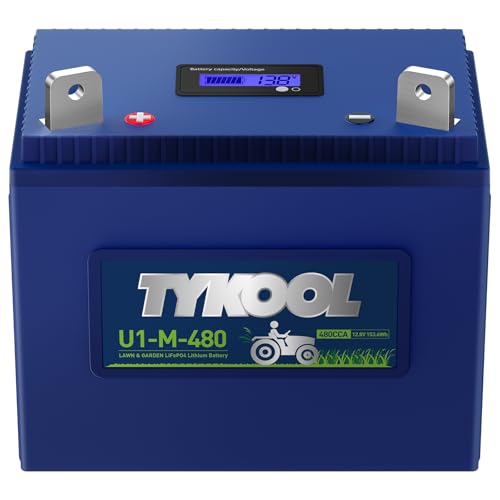
The TYKOOL 480CCA Group U1 lithium battery is the most purpose-built pick in this lineup for a modern garden tractor. LiFePO4 chemistry (lithium iron phosphate, a lithium variant prized for thermal stability and long cycle life) gives it an honest 480 cold cranking amps, which is plenty for a mid-sized John Deere, Cub Cadet, Craftsman, or Troy-Bilt rider with an engine in the 17 to 24 horsepower range. The Group U1 case means it drops into the stock battery tray without adapter plates or shimming.
Compare that to the lead-acid units higher up the list: this TYKOOL weighs roughly a third of what an AGM (absorbent glass mat, a sealed lead-acid design) equivalent does, and it does not need water top-ups or float charging through the off-season. For someone cutting two or more acres weekly, that weight savings shows up the first time they lift the hood.
A Few Highlights
- 480 cold cranking amps handle cool spring mornings without hesitation
- 12Ah capacity translates to longer accessory runtime between charges
- Cycle life rated above 3,000 charges, far beyond lead-acid
- Drop-in Group U1 footprint replaces many OEM batteries directly
- No acid, no corrosion, and no venting required in the engine bay
Worth Noting
- LiFePO4 packs cost more up front than a comparable AGM unit
- Some older charging systems may need a lithium-compatible voltage regulator
Feature Snapshot
Made For
Mid-sized garden tractor owners who want a modern lithium upgrade and are willing to pay more up front for years of maintenance-free cranking.
Look Elsewhere When
Someone running a smaller deck with a less demanding engine might prefer the TYKOOL YTX9-BS-PRO, which costs less and still handles light cranking duty.
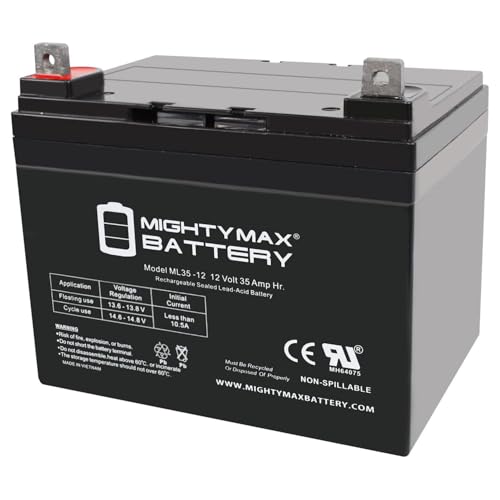
The Mighty Max 12V 35Ah battery is a classic high-capacity SLA (sealed lead-acid) unit sized for older John Deere lawn tractors and riders in the L100 and similar series. Where the smaller EnerSys Genesis only delivers 4Ah, this one carries 35 amp hours, which is real reserve for headlights, electric PTO clutches, and warm-weather starts on a flat yard. It ships without a wire harness, so expect to reuse the existing cables from the tractor.
Compared to the lithium picks on this list, the trade-off is weight. A 35Ah SLA runs around 22 to 24 pounds, so anyone servicing the battery frequently will feel it. For someone replacing an OEM battery on a budget, that weight is a small price for the price difference.
Points In Its Favor
- 35Ah capacity outranks most entry-level U1 lithium options for raw reserve
- Sealed AGM construction handles vibration and tilt without leaks
- Wide operating temperature range suits cold starts and hot summer decks
- Lower purchase cost than equivalent lithium replacements
Trade Offs
- Heavy at roughly 22 pounds, noticeable in smaller mower bays
- Cycle life is shorter than LiFePO4, so replacement comes sooner in heavy-use yards
- No wire harness included, requiring reuse of existing OEM cabling
Right Fit For
Older John Deere L-series riders and similar garden tractors where a high-capacity SLA swap restores factory-like starting without a lithium premium.
A Better Fit Elsewhere
Anyone wanting a lighter battery and longer service life should look at the TYKOOL 480CCA Group U1 lithium unit instead, which fits the same tray with far less weight.
The BRS U1 AGM battery arrives fully charged, which sounds like a small detail until you are standing in the garage with a dead tractor and a Sunday deadline. Open the box, drop it in the tray, hook the cables, and start mowing. The 300 cold cranking amps put it in the right zone for most lawn tractors and small UTVs, and the sealed AGM build means no fluid checks, no spill risk, and no corrosion creeping across the terminals.
The fitment is genuinely versatile. Lawn tractors, mowers, generators, UTVs, ATVs, and ride-on toys all fall within its wheelhouse. For someone owning more than one piece of equipment, that flexibility is genuinely useful.
Positive Takeaways
- Ships fully charged, eliminating initial setup time
- Maintenance-free sealed design appeals to set-and-forget owners
- Vibration-resistant build handles rough trails and uneven turf
- Works across mowers, generators, and small UTVs alike
Minor Gripes
- 300 CCA is on the lower side for very cold climates with large-displacement engines
- Lead-acid weight still applies, so expect a heavier lift than a lithium swap
Quick Facts
Best Suited To
Tractor owners in temperate climates who want a swap-and-go AGM with broad equipment compatibility and zero setup steps.
Swap It Out When
Cold-region owners with high-compression engines will appreciate the stronger cold cranking of the TYKOOL 480CCA Group U1 lithium battery.
The Renegade AGM battery for Cub Cadet 725-17335 is a direct-fit replacement designed to mirror the OEM dimensions exactly. For owners of a Cub Cadet riding mower, that matters more than raw amp hours, since a sloppy fit means the hold-down clamp cannot secure the battery and vibration does the rest of the damage over a season. This unit measures 5 7/8 by 3 3/8 by 4 1/4 inches, which matches the stock tray.
The 300 cold cranking amps give it enough muscle for a typical single-cylinder or small V-twin Cub Cadet engine. The sealed case keeps corrosion off the terminals, and owners who store their mower through winter without a tender should still find enough charge left come spring.
Benefits That Matter
- OEM-matched dimensions eliminate tray fitment guesswork
- Impact-resistant case holds up to deck vibration over rough ground
- 300 CCA handles typical Cub Cadet starter loads
- Sealed maintenance-free design removes routine fluid checks
Room For Improvement
- Capacity is modest compared to higher-amp-hour alternatives
- Brand-specific fit means it is not a versatile multi-equipment battery
Technical Sheet
Who Should Grab It
Cub Cadet riding mower owners who want a guaranteed OEM-fit replacement without measuring trays or improvising spacers.
Another Choice May Suit
Someone owning a John Deere rider or a different brand of tractor should pick the Mighty Max 12V 35Ah Battery, which suits a wider range of equipment.
The TYKOOL LFP20L-BS-PRO lands in motorcycle territory on paper, but its 12Ah LiFePO4 cell and 4.2 pound weight make it a sneaky option for smaller riding mowers, UTVs, and compact utility vehicles. For anyone whose tractor sits in a tight engine bay where every pound matters, this is a refreshing change of pace from a 20-plus pound SLA. It drops into Group 20L-compatible trays with common terminal spacing.
Its 600 cold cranking amps (CCA measures a battery’s ability to start an engine at 0 degrees Fahrenheit) actually exceed some of the AGM options here, which is the kind of surprise that makes lithium chemistry worth the upgrade cost. Anyone used to wrestling a heavy block into a Cub Cadet LT will feel the difference immediately.
Strong Points
- 600 CCA easily handles mid-sized mower and UTV starter loads
- At roughly 4.2 pounds, it cuts significant weight over lead-acid equivalents
- LiFePO4 cycle life outlasts AGM units by a wide margin
- Maintenance-free with no acid to inspect or top off
Points To Note
- Physical footprint matches Group 20L batteries, not Group U1, so measure your tray first
- Terminal orientation may differ from OEM posts on some mower models
Whose Shelf It Belongs On
Owners of compact UTVs, ATVs, and lighter riding mowers who want a lithium weight savings without sacrificing cranking power.
Not Your Match When
Someone with a larger garden tractor needing Group U1 fitment will find the TYKOOL 480CCA Group U1 Lithium Battery a more straightforward swap.
The TYKOOL LFP30L-BS-PRO is the heavyweight lithium in this group. With 800 cold cranking amps, an 18Ah capacity, an integrated LCD state-of-charge readout, and an IP66 water-resistance rating (meaning it resists powerful jets and dust intrusion, suitable for outdoor equipment), it is built for serious electrical demand. While it is marketed toward Harley touring and side-by-side UTVs, larger V-twin riding mower engines and diesel-generator start applications can absolutely take advantage of this output.
The built-in LCD screen is a genuine quality-of-life upgrade. Reading voltage and remaining capacity at a glance removes the guesswork that comes with a sealed lead-acid unit. The IP66 rating means a sudden rainstorm with the hood open will not phase it, which matters for equipment stored under a tarp rather than a garage roof.
Key Advantages
- 800 CCA covers the largest single and twin-cylinder mower engines
- LCD readout gives real-time voltage and state-of-charge visibility
- IP66 sealing handles wash-downs and outdoor storage
- Built-in 200A BMS (battery management system, an electronic safeguard that regulates charging and discharging) protects against overcharge and short circuits
Honest Caveats
- Premium price relative to AGM replacements
- Group 30L footprint is large, so measure the tray before ordering
Feature Rundown
Perfect Match For
Owners of larger riding mowers, side-by-side UTVs, or generator setups who want top-tier cranking power and real-time battery diagnostics.
Skip It When
A standard riding mower owner might find the BRS U1 AGM Battery a more cost-effective match, since most tractors do not need 800 CCA.
The TYKOOL YTX9-BS-PRO rounds out the list as an entry-level lithium option for small riding mowers, ATVs, and generators like the Honda eu3000is. At roughly 2.1 pounds and a footprint of 150 by 87 by 105 millimeters, it tucks into tight compartments where a bulky SLA simply will not fit. The 300 cold cranking amps and 5Ah capacity sound modest, but for a single-cylinder engine with a small starter, that is plenty of headroom.
Compared to the larger TYKOOL lithium options higher up the list, this one trades raw capacity for portability and price. For a homeowner with a smaller deck who wants lithium chemistry without the premium cost, this is the path of least resistance.
Reasons It Performs
- Lightweight at roughly 2.1 pounds, easy to handle and install
- Drop-in fit for YTX9-BS replacements on small riding mowers
- LiFePO4 chemistry rated for 2,000+ cycles
- Lower entry price than larger lithium tractor batteries
Practical Considerations
- 5Ah capacity limits use to smaller engines, not heavy-duty riders
- Lower CCA may struggle in very cold climates with stiff oil
Feature Card
Who Will Love This
Small riding mower and generator owners who want a lightweight lithium swap without paying for capacity they will never use.
Reach For A Different Pick When
Anyone with a larger garden tractor needing more cranking reserve should choose the TYKOOL 480CCA Group U1 Lithium Battery for stronger starting.
Picking A Replacement That Actually Fits
Battery choice for a riding mower looks simple until the tray sizes, post orientations, and CCA ratings start piling up. The right match comes down to three questions: what case group does the existing tray accept, how cold does the engine bay actually get, and how much weight does the install realistically tolerate.
Match the case group before anything else. Riding mower trays are designed around standardized battery group sizes, and U1 is the most common for residential tractors. Group 20L and Group 30L batteries fit different bays entirely. Measuring the tray, checking the post layout, and confirming the hold-down bracket clears the new case prevents returns and frustration. The Mighty Max 12V 35Ah Battery and the BRS U1 AGM Battery 12V 300 CCA both drop into U1 trays without fuss, while the heavier TYKOOL lithium units may require Group 20L or 30L spacing.
Cold cranking amps matter more in northern climates. CCA measures how much current a battery can deliver at 0 degrees Fahrenheit for 30 seconds while maintaining voltage. A tractor in Florida or coastal California rarely needs more than 200 to 250 CCA, but a property in Minnesota or upstate New York benefits from 300 CCA at minimum. The Renegade Replacement AGM Battery for Cub Cadet and the BRS U1 AGM Battery both sit at 300 CCA, while the TYKOOL LFP30L-BS-PRO pushes 800 CCA for the most demanding engines.
Lithium versus lead-acid is a weight-versus-cost decision. AGM and SLA batteries cost less and still deliver reliable starts, but they run heavy and lose capacity faster in deep-cycle use. LiFePO4 chemistry costs more up front yet lasts several times longer, weighs a fraction of an equivalent SLA, and charges faster between sessions. For anyone cutting multiple acres weekly, the lithium upgrade pays off across two to three seasons of use.
Capacity beyond cranking amps shapes accessory runtime. Tractors with headlights, electric PTO clutches, or USB charging ports draw on reserve capacity even with the engine off. A 35Ah SLA like the Mighty Max delivers longer accessory life between charges than a 12Ah lithium option, though lithium’s depth-of-discharge tolerance often evens out the real-world difference.
Key Considerations Across These Picks
Wrong Turns To Avoid
The most common mistake is choosing a battery by amp-hour alone without checking the case group. A 35Ah SLA that physically does not fit the tray cannot be strapped down safely, and vibration will destroy the internal plates within a season. The second slip-up is assuming all lithium batteries work with every charging system. Some older riding mowers have voltage regulators designed for lead-acid chemistry, and a lithium pack on a mismatched regulator can fail to charge fully or trigger error codes. Reading the mower’s manual for battery specifications before ordering prevents both pitfalls.
Where The Extra Money Goes
The premium on lithium batteries reflects three real differences: cycle life, weight, and consistency across temperature. A lead-acid AGM battery typically delivers 300 to 500 cycles before significant capacity loss, while LiFePO4 packs routinely exceed 2,000 to 3,000 cycles. Weight savings of 60 to 70 percent matter for anyone lifting the battery out for off-season storage. Temperature performance is steadier too, since lithium does not suffer the same capacity dropoff in cold weather that lead-acid does. For a homeowner replacing a battery every two or three years anyway, the AGM path still makes sense; for someone putting 200+ hours a season on a tractor, the lithium premium is recoverable over time.
Frequently Asked Questions
How do I know which battery group my riding mower takes?
Check the existing battery label for the group size, usually printed as U1, 20L, or 30L. Measure the tray dimensions if the label is gone, and compare those measurements against the replacement battery’s listed dimensions before ordering.
Can I use a lithium battery in any riding mower?
Most modern riding mowers with regulated 12V charging systems accept lithium batteries. Older tractors with unregulated alternators may need a voltage regulator check first, since overvoltage can damage LiFePO4 cells over time.
How long should a riding mower battery last?
A lead-acid battery typically lasts three to five seasons with proper maintenance, while a lithium battery can run five to eight seasons depending on usage and storage conditions. Storing the battery on a tender through winter extends life in either case.
Do I need to add water to a sealed AGM battery?
No. Sealed AGM batteries are factory-filled and maintenance-free, so they never require water top-ups. The acid is held in fiberglass mats inside the case rather than pooling at the bottom.
What happens if I install a battery with too few cold cranking amps?
The engine may crank slowly or fail to start in cold weather, and the battery’s lifespan shortens because it strains to deliver current beyond its rated capacity. Matching or exceeding the OEM CCA specification protects both the starter motor and the battery itself.
Wrap Up
The right battery depends on what the tractor needs and what the owner values. AGM units like the BRS U1 AGM Battery and the Mighty Max 12V 35Ah Battery remain solid, affordable choices for traditional sealed lead-acid replacements. Cub Cadet owners get a guaranteed fit from the Renegade Replacement AGM Battery for Cub Cadet. Lithium upgrades from TYKOOL bring real weight savings, longer cycle life, and stronger cold cranking for those willing to invest more up front. Measure the tray, check the case group, match the CCA to the climate, and the rest is straightforward.