A dead riding mower on the first warm Saturday of spring is a familiar headache. The right charger turns that stalled afternoon into a quick top-off, and the wrong one just adds frustration. I pulled together eight lawn mower battery chargers that handle common 6V and 12V setups, from compact trickle units to beefier shop-style boxes, so you can match the tool to the battery you actually own.
The Leading Options At A Glance

Linkstyle SAE Quick Connector Harness 1FT 10AWG

Tecmate Optimate 1 VoltMATIC TM-401a Bronze Series

PZP 0-15Amp 12V 24V Manual Battery Charger Maintainer

FOVAL 4-Pack Fully Automatic Trickle Battery Charger 12V

Unocho 6V/12V Battery Charger Maintainer 1.5A

Mroinge MBC022 12V 2A Lead Acid and Lithium Charger

Adakiit 4A Smart Car Battery Charger 6V 12V
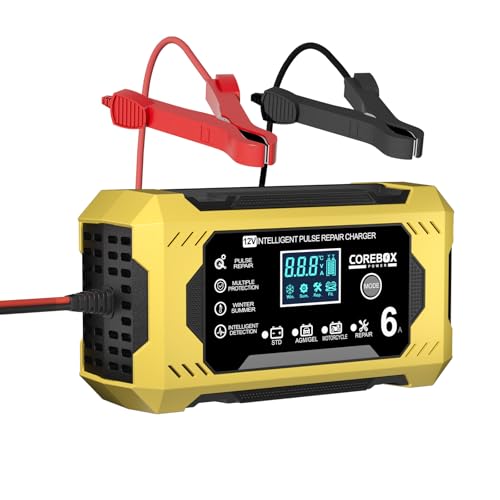
Corebox 6-Amp 12V Smart Battery Trickle Charger
Why These Options Stand Out
Most people shopping for lawn mower battery chargers want a finished charger, but sometimes the gap is wiring, not wattage. The Linkstyle SAE Quick Connector Harness is really a heavy-duty 1-foot jumper lead, and it shines when your existing charger is parked 18 inches too far from the mower’s posts.
The 10AWG pure copper conductors (that means thicker wire than the cheap 16AWG leads in most budget kits) handle the current without heating up, and the PVC jacket shrugs off the grease and grass clippings that collect under a mower seat. Rated for 12V to 48V systems at up to 30A, the pair of cables fits anywhere from a small mower to a solar array. Protective caps on both ends keep dust and rain out when the leads hang in the shed.
Useful Touches
- Thick 10AWG copper build resists voltage drop on short runs
- Polarized SAE plug fits the same port most modern trickle chargers use
- Dustproof caps reduce corrosion in unheated garages
- Two-cable pack means a spare for the trailer or generator
Worth Noting
- Only 12 inches long, so longer runs require stacking or a different cable
- Not a charger itself, so it pairs with another unit on this list
Who It Suits Best
Anyone who already owns a smart charger and just needs a rugged lead to bridge the gap between charger and battery in a tight mower bay.
Where Another Pick Suits Better
The Unocho 1.5A trickle charger is a better starting point if you need the actual charger and not just an extension.
Tecmate has built a quiet reputation among riders, and the Optimate 1 VoltMATIC TM-401a leans into that heritage. The big draw is the volt-sensing brain that figures out whether your mower battery is a 6V or 12V unit the moment you clip on, then runs a four-step program from there. For someone with a mixed garage of older tractors and newer riders, that auto-detection is genuinely useful.
The 0.6A output is gentle, which matters more than raw speed when the goal is to nurse a battery back over weeks rather than hours. Owners commonly rely on this style of charger for winter storage, hooking it up in November and forgetting about it until spring. The trade-off is patience, since deeply discharged batteries can take a day or more to recover at this pace.
What Works In Its Favor
- Auto-detects 6V versus 12V batteries on connection
- Continuous safe connection for months at a time
- Compact brick that hangs on a wall hook or sits on a shelf
- Compatible with AGM, GEL, and standard flooded cells
Honest Caveats
- Low 0.6A output means slow recovery on large dead batteries
- Lacks a quick-boost mode for jump-starting a no-start morning
Feature Snapshot
Made For
Owners who park their mower for months at a stretch and want a plug-in-and-leave-it solution that won’t cook the battery.
Look Elsewhere When
The PZP manual charger is a better fit when you need hands-on current control for stubborn, deeply discharged batteries.
Where the Tecmate hands the decisions to a chip, the PZP manual charger hands them to you. The dial runs anywhere from 0 to 15 amps across both 12V and 24V batteries, which sounds like overkill for a mower until you remember that riding mowers with bigger V-twin engines share their charging system with light trucks.
I like this style of unit for the homeowner who also runs a compact tractor or a small fleet of equipment. Crank it up to 10 amps for a quick recovery, then dial back to 2 amps for a steady absorption phase. The chassis is more like a piece of shop equipment than a consumer trickle charger, so it earns its spot on a bench rather than a shelf.
A Strong Showing
- User-controlled amperage from 0 to 15A across 12V and 24V systems
- Works as both a recovery charger and long-term maintainer
- Robust housing suited to a garage workbench
- Doubles as a charger for trucks and small tractor batteries
Points To Note
- Manual operation means you must monitor voltage to avoid overcharging
- Larger and heavier than the typical set-and-forget trickle units
- More capability than a single-mower owner truly needs
Quick Facts
Right Fit For
Garage tinkerers with multiple batteries across different vehicles who appreciate hands-on control.
Skip It When
The Unocho 1.5A is friendlier if you only own a single mower and want plug-in simplicity.
If the problem is more batteries than chargers, FOVAL’s four-pack is a tidy answer. Each unit delivers 1A (1000mA) at 12V through a four-stage program that moves from initialization to bulk charge, then absorption, then float mode. Float mode is the trick that lets a charger sit on a battery indefinitely without cooking it dry.
What I appreciate is the spread of use cases. The same charger that babysits your mower can sit on a motorcycle in winter, an ATV in storage, or a boat on a trickle. Most owners treat these as a fleet, labeling the cords and rotating them between vehicles.
What Pays Off
- Four chargers cover multiple machines at once
- Multi-chemistry support for SLA, VRLA, GEL, AGM, and wet cells
- Built-in desulfation (a pulse that breaks down lead sulfate crystals on tired plates)
- Compact housings tuck into tight battery trays
Trade Offs
- Single voltage, so 6V systems need a different charger
- 1A output is slow on bigger batteries over 50Ah
- More cables to manage than a single dedicated charger
Feature Card
Best Suited To
Households with a mower plus a motorcycle, ATV, or boat that all sit during the off-season.
Another Choice May Suit
The Tecmate Optimate 1 makes more sense for a single battery that needs a longer, more careful recovery.
Some chargers feel like they were designed for people who already know what they are doing. The Unocho 1.5A is the opposite. The 5-stage smart program runs through battery detection, soft start, bulk charge, absorption, and finally float, and the housing carries a single LED panel that walks you through the stage by color.
The 1.5A output is a step up from the 1A trickle units, so it pulls a small battery back from a deep discharge a bit faster without crossing into risky territory. Chemistry support is broad, covering SLA, AGM, GEL, VRLA, WET, and deep-cycle batteries, which means it works on a wider variety of mowers than most entry-level units.
Good Reasons To Consider
- 5-stage smart charging with clear status indicators
- Handles 6V and 12V batteries without swapping cables
- Wide chemistry support fits most small engine batteries
- 1.5A output balances recovery speed and safety
Practical Considerations
- No desulfation stage, so older batteries may need a more aggressive charger
- Included lead length is modest, so plan on extension cables for some setups
Who Should Grab It
First-time charger owners who want a forgiving, automatic unit that does not require babysitting.
Reach For A Different Pick When
The Corebox 6-amp charger makes more sense for larger riding mower batteries that need faster recovery.
Most trickle chargers on this list assume a lead-acid battery, but lithium iron phosphate (LiFePO4) batteries need a different charging curve, and using the wrong charger can shorten their life. The Mroinge MBC022 stands out because it covers both worlds with a switchable mode for 12V lead-acid and 12V LiFePO4 chemistries.
The 2A output lands between the gentle 1A units and the heavier 4A to 6A chargers, making it a flexible middle ground. Safety is the other quiet strength, with spark-proof connection, reverse polarity protection, and short-circuit defense built in. For newer lithium-equipped mowers, that switchable chemistry is genuinely useful.
What Earns Its Place
- Supports both lead-acid and LiFePO4 chemistries via mode switch
- Multi-level safety protections including reverse polarity and over-temperature
- Bad battery detection prevents charging a damaged cell
- 2A output handles small and mid-size batteries efficiently
Where It Is Less Suited
- No 6V mode, so older 6V tractors need a different charger
- Mode must be selected manually, so double-check before connecting
Technical Highlights
Perfect Match For
Anyone who owns a newer lithium-equipped mower or a mixed fleet with both lead-acid and LiFePO4 batteries.
A Better Fit Elsewhere
The Unocho 1.5A is a smarter pick when all of your batteries are traditional lead-acid and you want the simplest possible setup.
The Adakiit 4A sits in the middle of this list by design. It handles both 6V and 12V systems, runs an 8-stage charging program through diagnosis, desulfation, bulk, absorption, recondition, and float, and the 4A output is enough to wake up a sluggish riding mower battery overnight without the bulk of a shop charger.
I appreciate the fused ring connectors (50A fuses on the leads) as a small but meaningful safety upgrade. Capacity range is wide, from 4Ah up to 120Ah, so it covers everything from a small push mower to a large garden tractor. The visible progress display takes the guesswork out of where the charge stands.
The Practical Payoff
- 8-stage charging program includes recondition and desulfation
- 50A fused ring connectors add a layer of safety
- Works on batteries from 4Ah to 120Ah
- Doubles as a trickle charger once full charge is reached
Less Ideal Details
- 4A output is overkill for tiny mower batteries and may shorten their life if left on too long
- Larger housing than the small 1A to 1.5A units
Whose Shelf It Belongs On
Riders with mid-size to large engines who want faster recovery than a 1A to 1.5A trickle can deliver.
Swap It Out When
The Corebox 6A is worth a look when you also want active temperature compensation for hot or cold storage.
When a mower sits in an unheated shed through January, the temperature swings are brutal on a battery. The Corebox 6-amp charger is built around that problem. It carries temperature compensation, meaning it adjusts output voltage up in cold weather and down in hot weather so the battery receives what it actually needs rather than a fixed number.
The 6A output is on the punchier side of this list, which shortens recovery time on larger riding mower batteries. Eight charging protections cover reverse polarity, short circuit, and over-temperature, and the housing acts as a passive heat sink so it runs quieter than fan-cooled units.
The Value In It
- Temperature compensation adjusts charge voltage to climate
- 6A output shortens recovery on larger batteries
- 8 charging protections including reverse polarity and over-temperature
- Functions as charger, maintainer, trickle, and desulfator
Things To Weigh
- 12V only, so 6V batteries need a separate charger
- Higher amperage is more than tiny push-mower batteries require
Spec Overview
Built With In Mind
Homeowners in cold climates who store their mower through long winters and want a charger that adapts to temperature swings.
Not Your Match When
The Tecmate Optimate 1 is a better pick for 6V batteries or for owners who want a gentler long-term maintenance pace.
What To Weigh Before Picking A Lawn Mower Battery Charger
Before committing to a charger, match the unit to your battery’s voltage and chemistry. Most modern riding mowers run 12V lead-acid, but older lawn tractors from the 1980s and 1990s often carry 6V batteries, and a mismatched charger can fry the cells in a single afternoon. Check the battery label, then pick a charger that lists that voltage and chemistry explicitly.
Amperage Shapes Daily Use
A 1A to 1.5A trickle charger is the right pace for long-term maintenance, slow recovery, and small batteries under 20Ah. Once you cross into larger riding mower batteries in the 30Ah to 50Ah range, a 4A to 6A charger recovers the battery faster without sitting on it for days. Higher amps also mean more heat, so the smallest battery in your garage can suffer under a charger built for a truck.
Smart Programs Add Real Safety
Multi-stage smart chargers move through bulk charge, absorption, and float automatically. Float mode is the stage that lets you leave the charger connected indefinitely, since it drops voltage to a level that prevents overcharge. Manual chargers skip this automation, so the user has to babysit voltage, which is fine for tinkerers but risky for set-and-forget use.
Climate And Storage Conditions
Cold storage shortens battery life, and a charger with temperature compensation adjusts output to keep voltage on target when the thermometer drops. For unheated sheds, garages, or barns, that feature is worth a small premium. Dust and moisture are also worth weighing, since shed environments tend to be less clean than a basement workshop.
Key Considerations Across These Picks
Where Shoppers Go Wrong
The most common mistake is choosing a charger based on output speed alone. A 6A charger sounds better than a 1A trickle, but on a small push mower battery the higher current can overheat the plates and shorten life. Match the amperage to battery capacity, not to impatience. Another trap is overlooking voltage, since a 12V-only charger connected to a 6V battery delivers double the intended voltage and damages the cells immediately.
What Separates Premium From Basic
Higher-tier models earn their price through smarter charging programs, temperature compensation, and broader chemistry support. The basic units do the job for a single lead-acid battery in mild conditions, but premium picks handle lithium chemistries, climate swings, and larger battery banks. The upgrade is worth it when you own multiple vehicles, store equipment in unconditioned spaces, or want long-term plug-and-forget safety without monitoring voltage yourself.
Frequently Asked Questions
How Long Does It Take To Charge A Lawn Mower Battery?
Most small mower batteries recover in 4 to 12 hours on a 1A to 2A trickle charger, while larger riding mower batteries can take 12 to 24 hours on the same charger. A 4A to 6A unit cuts that time roughly in half.
Can I Leave A Battery Charger Connected All Winter?
Yes, as long as the charger has a float mode or automatic maintenance stage. Chargers without float mode can overcharge and damage the battery over weeks of continuous connection.
Will A Trickle Charger Bring A Completely Dead Battery Back?
It depends on how dead the battery is. A trickle charger can recover a deeply discharged but otherwise healthy battery over several days. A battery that reads below 10V and has sat that way for months may be permanently sulfated and need replacement.
Are Lithium Mower Batteries Compatible With Standard Chargers?
No. LiFePO4 batteries require a charger with a specific lithium charging profile, like the Mroinge MBC022. Using a lead-acid charger on a lithium battery can shorten its life or pose a safety risk.
Do I Need A Different Charger For 6V And 12V Batteries?
Only if your charger is single-voltage. Dual-voltage chargers like the Tecmate Optimate 1 or Unocho handle both automatically. A 12V charger on a 6V battery will damage it, so always verify the battery label before connecting.
The Takeaway
The right charger comes down to your battery’s voltage, the chemistry it uses, and how long it sits between uses. A gentle trickle unit like the Unocho or FOVAL fits most weekend mowers, while the Corebox and PZP earn their place for larger batteries and tougher storage conditions. Match the tool to the battery in front of you, and spring startup stops being a guessing game.