A push mower running across dry grass can hit 95 to 100 dB, and a riding mower climbs higher. Long-term exposure to that kind of noise leads to hearing fatigue, ringing ears, and damage that accumulates quietly over years. I put together this roundup for homeowners and weekend yard warriors who want something on their head that protects their hearing, stays comfortable through a full yard, and maybe plays music or takes a call without yanking the muffs off.
The Lineup, Simplified
The Lineup, Simplified

3M Peltor Optime 98 Over-The-Head Earmuffs H9A

3M PELTOR X3 Earmuffs Behind-the-Head

3M PELTOR Hearing Protection Ear Muffs NRR 24 dB

PROHEAR 037 Bluetooth 6.0 Safety Ear Muffs
PROHEAR 027 AM FM Radio Safety Earmuffs

PROHEAR 033 Bluetooth 5.4 Safety Earmuffs

TOZO NC9 Hybrid Active Noise Cancelling Earbuds
More On The Choices That Made The List
Pulling these out of the package, the 3M Peltor Optime 98 reads like the old guard of hearing protection, which is exactly the point. The Optime line is divided into numbered tiers matched to eight-hour time-weighted average noise exposures, and the 98 tier is the middle step intended for environments sitting around that threshold. For a typical suburban yard with a gas push mower, that rating lands in the right neighborhood.
Where it differs from the others on this list is simplicity. No Bluetooth, no radio, no charging port. You put them on, the world goes quiet, and that’s the whole job. Homeowners who already stream music from a wrist strap speaker, or who simply prefer the calm, will appreciate that no-fuss approach. Compared to the PROHEAR models below, you trade entertainment for a lighter, less feature-heavy shell.
Well-Handled Touches
- Numbered Optime tier system takes the guesswork out of matching protection to noise level.
- Over-the-head band keeps the cups sealed through long mowing sessions without slipping.
- Passive design means no batteries to forget before Saturday morning yard work.
- Trusted safety brand commonly seen on construction sites and in home workshops.
Things To Consider
- No music or radio means you’ll rely on a separate speaker if you want background audio.
- The full over-the-head band can fight with caps or wide-brim sun hats.
- Cups run warmer than vented earbuds during summer stretches.
Who It Suits Best
Casual homeowners with a modest yard and a push mower who want a no-nonsense passive muff.
Not Your Match When
You want Bluetooth audio built in. In that case the PROHEAR 037 brings streaming and a much higher SNR rating to the same job.
The X3 sits higher in the Peltor family than the Optime 98, and it shows up in industrial catalogs aimed at construction and manufacturing floors. The behind-the-head band is the standout physical choice here, since it lets you wear a hard hat, a baseball cap, or a wide sun hat without the headband fighting for space. NRR, or Noise Reduction Rating, is the U.S. system for measuring how many decibels a hearing protector knocks off, and X3-series models typically land in a strong attenuation band.
For lawn work, the behind-the-head profile is genuinely useful. I find this style more comfortable when I’m ducking under low branches or pausing to wipe sweat off my forehead. Unlike the previous Optime 98, there’s no overhead strap to bump against hat brims, but you also lose the option to hang the muffs loosely around your neck between passes.
Real Benefits
- Behind-the-head band clears the crown of the head for hat wearers.
- Higher-tier X3 attenuation for louder equipment like tillers and leaf blowers.
- One-size-fits-most headband adjusts without tools.
- Lower-profile fit sits more comfortably against the back of a seat or backpack strap.
Honest Caveats
- No audio features at all, which is a downgrade if you streamed music through your last pair.
- Behind-the-head style can tug hair at the nape of the neck.
Key Product Details
Built With In Mind
Anyone mowing, trimming, or leaf-blowing who also wears a cap or hard hat and prefers passive protection.
A Better Fit Elsewhere
Skippers who need built-in audio should reach for the PROHEAR 033, which adds Bluetooth and FM/AM radio in a similar over-ear shell.
This is the workmanlike middle child of the Peltor over-ear lineup: a familiar over-the-head band, a stated NRR of 24 dB, and a price that usually sits well below the X3. The NRR 24 figure is the headline spec because it tells you, in plain numbers, how much noise the muffs are designed to knock down. For most residential mowing situations, that ceiling is more than enough headroom.
In the yard, the comfort story is straightforward. The headband spreads clamping pressure across the crown, and the cups seal around typical ear shapes without aggressive squeeze. Owners commonly mention that the seal softens after a few weeks of break-in. If you want something that feels familiar right out of the box, this is the easiest Peltor to grab.
Strengths Worth Knowing
- Stated NRR 24 dB provides solid headroom over typical mower noise levels.
- Over-the-head design stays put during repetitive motion like pushing or trimming.
- Plain passive operation means zero charging or pairing hassles.
Trade-Offs
- No audio passthrough or Bluetooth at this tier.
- Cup cushioning can compress with sweat over a hot summer and need wiping between sessions.
Quick Facts
Right Fit For
Homeowners who mow weekly with a gas push mower and want a durable, no-frills Peltor.
Look Elsewhere When
You want a single pair that also plays music. The PROHEAR 037 doubles as a Bluetooth headphone without sacrificing protection.
Here’s where the roundup starts leaning into hybrid territory: hearing protection plus consumer electronics. The PROHEAR 037 pairs over-ear safety cups with Bluetooth 6.0 streaming and a 1100mAh rechargeable battery, plus a stated 30 dB SNR, which is the European-style counterpart to NRR and runs on a slightly different measurement scale. SNR, or Single Number Rating, characterizes hearing protector performance under lab conditions.
For long mowing sessions, the math gets attractive: a rechargeable battery that supports around 120 hours of playback means a single weekend top-up covers most yards. Owners commonly mention using these during snow blowing in winter and lawn mowing in summer with the same pair. The trade-off versus the bare Peltor models is weight and a small charging routine.
Reasons It Performs
- Bluetooth streaming turns the muffs into yard headphones for podcasts and playlists.
- Long playback window per charge supports full-day yard work.
- 30 dB SNR offers meaningful protection for gas mowers and trimmers.
- Reusable design works across seasons, not just mowing.
Points To Keep In Mind
- Battery needs charging, so dead-on-arrival mornings can leave you with passive-only sound.
- Heavier shell than pure passive Peltor muffs can press on the jaw during long sessions.
Feature Snapshot
Perfect Match For
Yard owners who want their mowing soundtrack and their hearing protection in one shell.
Skip It When
You’d rather keep things strictly passive. The 3M Peltor Optime 98 delivers straightforward protection with no charging needed.
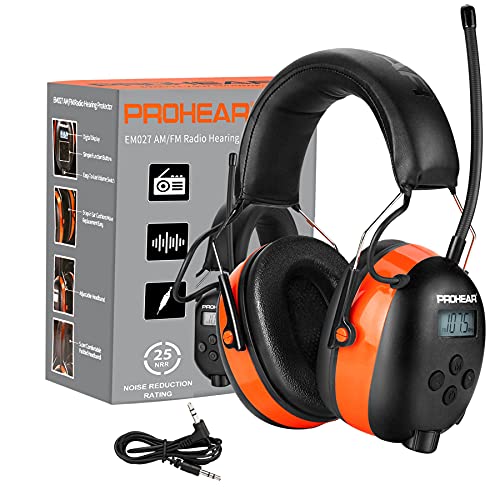
Not everyone wants to bring a phone into the yard. The PROHEAR 027 takes a different angle with a built-in AM/FM radio and a small digital display, so you tune into a station the way you would on a kitchen counter radio. There’s no pairing, no app, no streaming account. The shell still does its safety job with a stated NRR of 25 dB.
Where I find this design clever is in the high-visibility orange shell. Standing at the curb with a trimmer, the bright color helps passing cars and family members spot you. The ABS plastic housing is light enough for a long stretch of edging, and the ear cushions stay soft through warm afternoons.
Everyday Wins
- Built-in radio removes dependence on a phone or playlist.
- High-visibility color adds passive safety around driveways and roadsides.
- NRR 25 dB handles most residential mowing and trimming noise.
- Digital display makes station changes quick even with gloves on.
Small Caveats
- Reception can drop in rural valleys far from transmitters.
- No Bluetooth means streaming from your phone isn’t an option here.
Feature Rundown
Who Should Grab It
Listeners who’d rather scan local stations than carry a phone into the yard.
Reach For A Different Pick When
You want Bluetooth and radio in one unit. The PROHEAR 033 covers both inputs at a similar protection level.
The PROHEAR 033 is the most flexible unit in the lineup, because it adds Bluetooth 5.4 streaming on top of an AM/FM radio, all wrapped in an OSHA-compliant shell with a stated NRR of 25 dB. OSHA, the Occupational Safety and Health Administration, sets U.S. workplace hearing protection benchmarks that this rating aligns with. For a homeowner that just means the spec was designed with serious industrial standards in mind.
Battery life sits around 48 hours of playback, which is shorter than the 037 but still covers several weekends between charges. Compared to the PROHEAR 027 above, you gain streaming flexibility without losing the radio option. For mixed-use households with both yard and workshop time, the dual input setup pays off.
What Makes Sense
- Bluetooth plus AM/FM means you can switch between streaming and broadcast easily.
- 25 dB NRR aligns with common workplace hearing safety benchmarks.
- Rechargeable design supports multi-session use.
- Cushioned headband spreads pressure for longer mowing days.
A Few Limitations
- Heavier than passive muffs, so neck fatigue can show up on long jobs.
- More buttons mean a short learning curve for first-time users.
Specs
Made For
Yard and workshop owners who want maximum audio flexibility alongside solid protection.
Swap It Out When
You mostly mow for an hour or two each Saturday and want something lighter. The 3M PELTOR X3 offers a quieter, simpler passive experience.
The TOZO NC9 is the outlier of this roundup: true wireless earbuds with hybrid active noise cancelling rather than passive earmuffs. ANC, or Active Noise Cancellation, uses built-in microphones and anti-phase sound waves to cancel low-frequency hum, which is why these work well on planes and AC hum. For mowing, the trade-off is real, and worth being honest about.
Where these shine is in lighter yard tasks: trimming around flower beds, blowing leaves with a low-power blower, or doing detail work away from the loudest equipment. Active cancellation handles steady droning noise better than impact spikes from a push mower. Owners commonly report that ANC helps with mower drone but is not a substitute for dedicated muffs around louder tools.
Key Advantages
- Lightweight earbuds disappear in the ear during long detail work.
- Hybrid ANC targets low-frequency drone from mowers and blowers.
- Around 60 hours of total battery life with the charging case.
- LED display shows remaining charge at a glance.
Practical Considerations
- Not a substitute for NRR-rated muffs around the loudest gas equipment.
- Earbuds can work loose during vigorous movement.
- Noise cancellation needs battery power to do its job.
At A Glance
Best Suited To
Yard owners doing lower-noise detail work like edging, light blowing, or trimming who value a low-profile fit.
Consider Something Else When
You’re spending hours on a gas push mower. The PROHEAR 037 adds serious NRR-equivalent protection that earbuds can’t match.
What Matters Most When Choosing Lawn Hearing Protection
Match The Protection Rating To Your Mower
Push mowers typically run between 90 and 100 dB, while riding mowers and tractors can climb above that. A higher NRR or SNR rating gives you more headroom. For a quiet electric mower, a lower-rated muff or ANC earbuds may be enough.
Decide Between Passive Muffs And Active Earbuds
Passive earmuffs physically block sound waves with dense cup material. Active noise cancelling uses microphones and anti-phase sound waves to cancel low-frequency drone. Around loud gas equipment, passive protection generally wins on safety margin.
Think About Comfort Across A Full Yard
Clamping pressure, headband shape, and cup cushioning decide whether you finish the back forty or rip the muffs off halfway. Behind-the-head bands work well under hats. Over-the-head bands spread pressure differently. Try the wearing style before committing.
Weigh Audio Features Against Added Weight
Bluetooth and radio add convenience, but also add battery weight and a charging routine. If your mowing sessions are short, a passive Peltor may suit you better than a feature-rich PROHEAR shell.
Key Considerations Across These Picks
Where Shoppers Go Wrong
The biggest slip-up is assuming any headset marked “noise cancelling” protects your hearing equally. ANC earbuds handle drone but not impact noise. Conversely, choosing the highest NRR muff on the shelf can leave you overprotected for a small yard, with muffs so heavy you stop wearing them.
What Separates Premium From Basic
Higher-priced safety headphones usually add wireless streaming, longer battery life, dual audio sources, or hybrid shells that mix ABS and softer cushion materials. The upgrade is worth it when you mow often enough that the extra comfort or audio turns the chore into something you actually finish.
Frequently Asked Questions
Do noise cancelling earbuds protect hearing while mowing?
True wireless earbuds with ANC can reduce the steady drone of an electric mower, but they typically don’t match the NRR of dedicated earmuffs around gas equipment. For full yard sessions, NRR-rated muffs remain the safer pick.
What NRR do I need for lawn mowing?
For a residential push mower in the 90 to 100 dB range, an NRR of 24 dB or higher is a comfortable safety target. For riding mowers and tractor work, leaning toward 25 to 30 dB SNR gives extra headroom.
Can I listen to music safely through hearing protection?
Yes, as long as the volume stays moderate and the muff still attenuates outside noise. Bluetooth-equipped safety muffs like the PROHEAR 037 are designed for exactly that workflow.
Are behind-the-head earmuffs less comfortable than over-the-head?
They feel different rather than worse. Behind-the-head bands sit clear of the forehead and work well under hats, while over-the-head bands spread pressure across the crown. Comfort comes down to personal fit.
How long do rechargeable safety earmuff batteries last?
Most rechargeable safety muffs in this category run between 30 and 120 hours of playback per charge, depending on the model and volume. For weekly mowing, a monthly top-up is usually plenty.
Closing Remarks
The right pair of muffs turns mowing from something you rush through into a quieter, more tolerable stretch of the week. Match the protection level to your equipment, decide whether audio features matter, and pick a wearing style that fits your head and your hat. Your ears will thank you a decade from now.